
Roof Replacement in Houston, TX
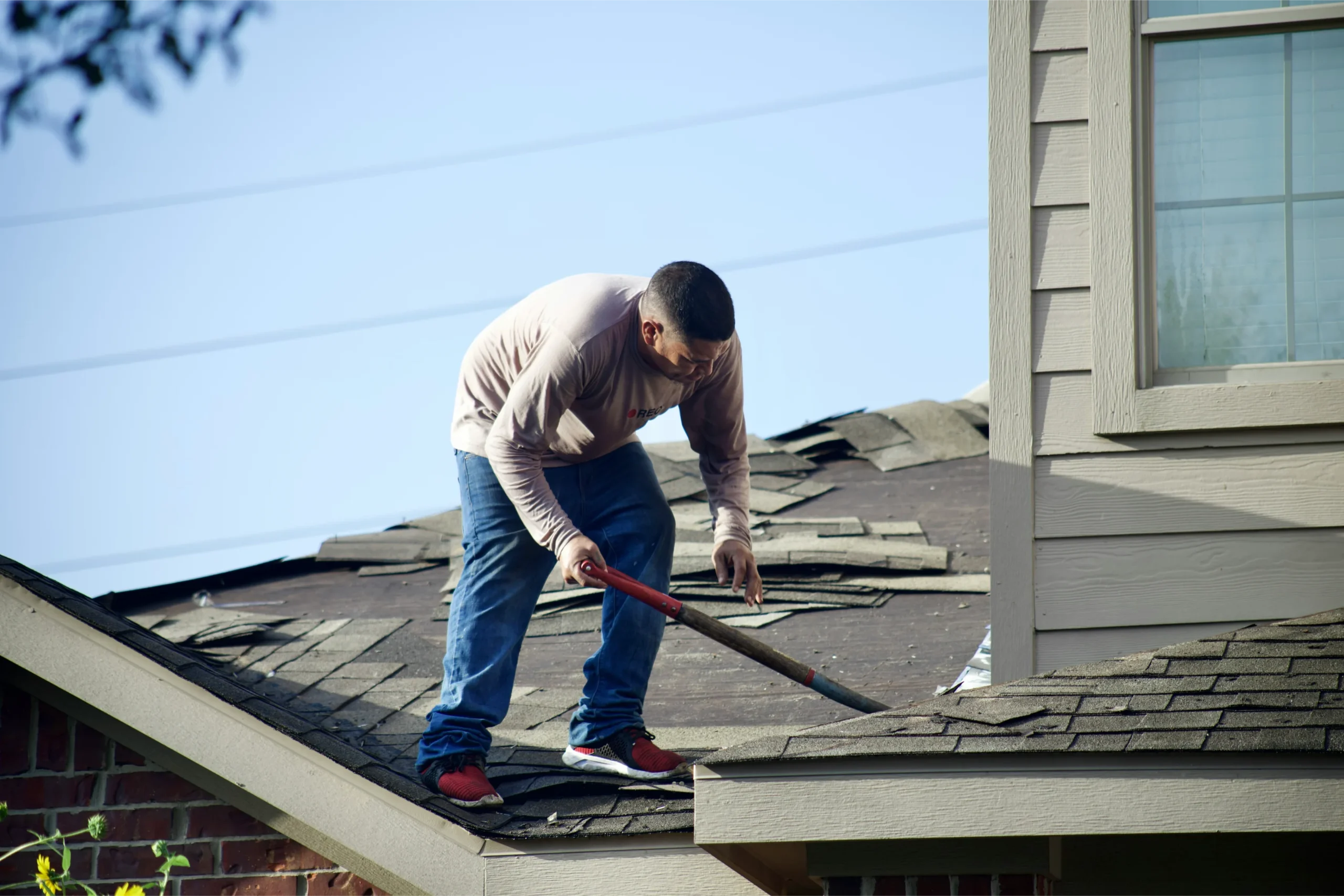
A roof replacement is not new shingles on an old roof. It is a full tear-off down to the decking, and a complete new roof system built back up from bare wood.
By RoofDetect Pro — Last updated: November 20, 2026
For roof replacement Houston homeowners, the first question is never the price. It is whether the roof needs replacing at all — because a repair on a young roof is a few hundred dollars, and a replacement on a roof that could have been repaired is ten thousand dollars spent too soon. Get that decision right, and everything after it is straightforward.
Call (831) 623-8078 — free roof inspection and written estimate, no obligation.
Availability varies by ZIP code, time and service — call (831) 623-8078 to confirm. Weekend and holiday availability is not guaranteed everywhere.
Repair or Replace? The Cost Rule
Roof replacement Houston decisions come down to three tests, and a roof that fails all three is a roof to replace.
The money test. If the repair bill is approaching a large share of a replacement quote, and the roof is near the end of its life, replacement is usually the better spend: you are paying a large fraction of a new roof’s price for a repair on a roof with little life left. GAF, the largest shingle manufacturer in North America, draws the same line in its repair-or-replace guide: small, localized damage is usually a repair, while significant or widespread damage usually means a replacement. Our roof repair page covers the repair side, and GAF’s repair-or-replace guide walks through the same decision.
The age test. A roof under 15 years old with local damage is usually a repair. A roof over 15 years old with damage showing in more than one place is usually a replacement — the material is past the point where patching buys real time. Standard 3-tab shingles in Houston heat and humidity rarely last beyond 18–22 years; architectural shingles reach 25–30. A 25-year shingle at 27 years is past its design life, and repairing it is repairing something that will need replacing within a few years regardless.
The stacking test. One repair is a repair. Repairs that keep coming back — a leak fixed in spring, another in summer, flashing re-done in autumn — mean the system is failing, not a spot on it. When the repairs stack up and the roof is 15–20 years old, the next repair is the most expensive way to delay a replacement.
If the roof passes all three tests — young, damage local, repairs rare — repair it. If it fails two or three, replace it. The inspection is what settles it: our roof inspection page covers what that visit checks, and our storm damage page covers the repair side after a storm, including the claim steps.
Signs Your Roof Needs Replacing
Not every roof problem means replacement — but these signs, together, usually do:
- Age past its design life. 3-tab shingles at 20+ years, architectural shingles at 25–30, in Houston heat. Whole Houston subdivisions went up in waves, so entire streets hit the 15-to-20-year mark at the same time — right when spring hail finishes them off.
- Widespread granule loss. Check your gutters: excessive granules mean the shingles have lost their UV and weather protection. Granule loss across large sections, not just around flashing, means the shingles are at end of life — repairing one section does not extend the rest.
- Curling, buckling or missing shingles across more than 30% of the roof. A few curled shingles are a repair. Curling across a third of the roof is a roof that has given up.
- Multiple leaks in different places. One leak at a flashing point is a repair. Three or more active leaks across different areas mean the system has failed, not one spot. Our roof leak detection page explains how leaks are traced — and when tracing stops being worth it.
- Soft or sagging decking. Soft spots underfoot, a visible sag, or daylight showing in the attic mean the decking underneath has rotted. A patch does not fix a deck; a replacement does.
- Hail damage across several slopes. After a hailstorm, damage on one slope may be repairable. Damage across several slopes usually means a full replacement — and it is often the kind of damage insurance covers. See our signs you need roof repair after a Houston storm guide for what storm damage looks like.
- Repairs that keep stacking up. The stacking test above: when every season brings a new repair, the roof is telling you it is done.
One of these signs alone is a conversation. Three or four together is an answer.
What a New Roof Actually Is
A new roof is a system, not shingles. Shingles are the part everyone compares — but shingles are rarely what fails first. Leaks start at flashing, valleys, penetrations and ventilation. Here is everything that goes on your roof, and what each part does:
- Decking. The plywood or OSB the whole roof sits on. If it has softened from an old leak it will not hold a nail, and nothing above it will last. Decking is inspected sheet by sheet once the old roof is off, and rotten sheets are replaced before anything goes on.
- Leak barrier. A self-adhering membrane in valleys and around penetrations — the places water actually gets in. This is the layer that matters most and the one most often skipped on a cheap quote.
- Deck protection. Synthetic underlayment across the whole deck. It keeps water out during installation and gives a second line of defence afterwards. Felt paper is the older, weaker version; synthetic is the standard on a proper Houston job.
- Starter strips and drip edge. The first course and the metal edging. Gulf Coast wind lifts shingles from the edge inward, so this is where wind damage begins — or does not.
- Shingles. The visible layer. Architectural shingles are the standard Houston choice; impact-resistant (Class 4) shingles are built for hail.
- Flashing. New flashing at every valley, chimney, skylight, vent and wall joint. Flashing is skilled labour, and it is where most leaks start — old flashing reused under a new roof is a leak waiting to happen.
- Ventilation. Ridge vents or box vents sized for proper attic airflow. Trapped heat cooks a roof from underneath and can halve its life — Houston attics reach far higher temperatures than the shingles were rated against.
- Ridge cap. Purpose-made ridge cap, not cut-up field shingles. The ridge takes the most wind exposure on the roof.
The parts you can see are the shingles, the ridge line and the edge metal. The four that decide whether it leaks are underneath — and they are the four a low bid leaves out.
Tear-Off vs Overlay: Never Lay New Over Old
Most roof replacement Houston jobs start with a full tear-off: everything comes off, down to bare decking. There is a cheaper alternative — an overlay, laying new shingles over the old ones — and it is the wrong job in Houston for four reasons:
- It hides the deck. The whole point of a tear-off is seeing the decking. An overlay hides rotten plywood, and roofing over a compromised deck shortens the life of the new roof and creates a problem nobody can see until it is worse.
- It adds weight. A second layer adds deadweight the roof trusses were not designed for, and traps attic heat under the new shingles.
- It voids the shingle warranty. Most shingle manufacturers void the warranty on a re-roof installed over an existing layer. A new roof with no warranty is not a new roof.
- Texas allows at most two layers. If your roof already has two layers, a tear-off is not a choice — it is required. And even with one layer, a full tear-off is the only way to know what you are working with before new material goes down.
A quote that is far below the others is often an overlay quote. Check whether it says “tear-off” before you compare prices — if it does not, you are comparing two different jobs.
Shingle vs Metal vs Tile: Choosing the Material
Material is the single biggest cost decision, and it is also a 20-year decision: the cheapest roof that fails in a Houston hailstorm is the most expensive roof you can buy.
| Material | Published US national range | Lifespan | Houston fit |
|---|---|---|---|
| Architectural shingles | $4–$6 / sq ft | 20–30 years | The standard choice — cheapest, fastest, 1–2 day install |
| Impact-resistant (Class 4) shingles | $5.50–$7 / sq ft | 25–30 years | Built for hail; worth pricing on any Houston roof |
| Standing seam metal | $8–$14 / sq ft | 40–70 years | Roughly double asphalt up front, roughly double the life; sheds heat |
| Clay / concrete tile | $10–$20 / sq ft | 40–50 years | Lifetime roof, lifetime price — needs a structure check first |
| Slate | $15–$30 / sq ft | 75+ years | Rare in Houston; the longest life and the highest price |
Ranges: published US national ranges from our 11 Nov research table (same ranges Blog 1 uses) — not RoofDetect Pro’s prices and not Houston prices. Angi’s roof replacement cost guide publishes the national ranges behind these figures.
Architectural shingles are the most common Houston choice because they are the cheapest and the fastest to install. Impact-resistant (Class 4) shingles cost more per square foot but are built for hail — with Houston seeing several hail events most years, per the National Weather Service’s severe weather statistics, they are worth pricing on any roof, and many Houston installers use a 6-nail fastening pattern rated to 130 mph wind. Metal costs roughly double asphalt up front and lasts roughly double as long, and it sheds heat — a real consideration in a Houston summer. Tile is a lifetime roof with a lifetime price, and it is heavy: not every Houston frame was built for it, so the structure is checked first. And on a tile roof, ask about the underlayment, not the tiles — tiles can look fine for decades while the underlayment underneath fails at around 25–30 years. Flat or low-slope sections — a porch, an addition, a garage — take a membrane system (TPO or modified bitumen), not shingles; see our flat roof repair page for how those roofs work.
The Replacement Process, Day by Day
A roof replacement Houston crew usually finishes a standard-pitch asphalt roof in 1–3 days. Steep, large or cut-up roofs, tile and metal take longer — typically 3–5 days. Here is what happens, and when:
Before the crew arrives — inspection and written estimate. The roof is walked, the attic is checked where there is access, and everything is photographed. You get one price in writing, with the system specified — material, underlayment, flashing, ventilation, decking rate per sheet, permit, and clean-up. If a quote is one line and one number, it is a guess, not an estimate.
Day 1 — tear-off and decking. The crew arrives early, tarps go over shrubs, pools and AC units, and the old roof comes off down to bare decking. Every sheet of decking is inspected for rot, soft spots and delamination, and damaged sheets are replaced before anything goes on. Houston homes average 5–10% deck replacement from moisture — and this is where a quote grows, because nobody knows how many sheets are needed until the roof is open. Ask the per-sheet decking rate before you sign, not after the roof is open.
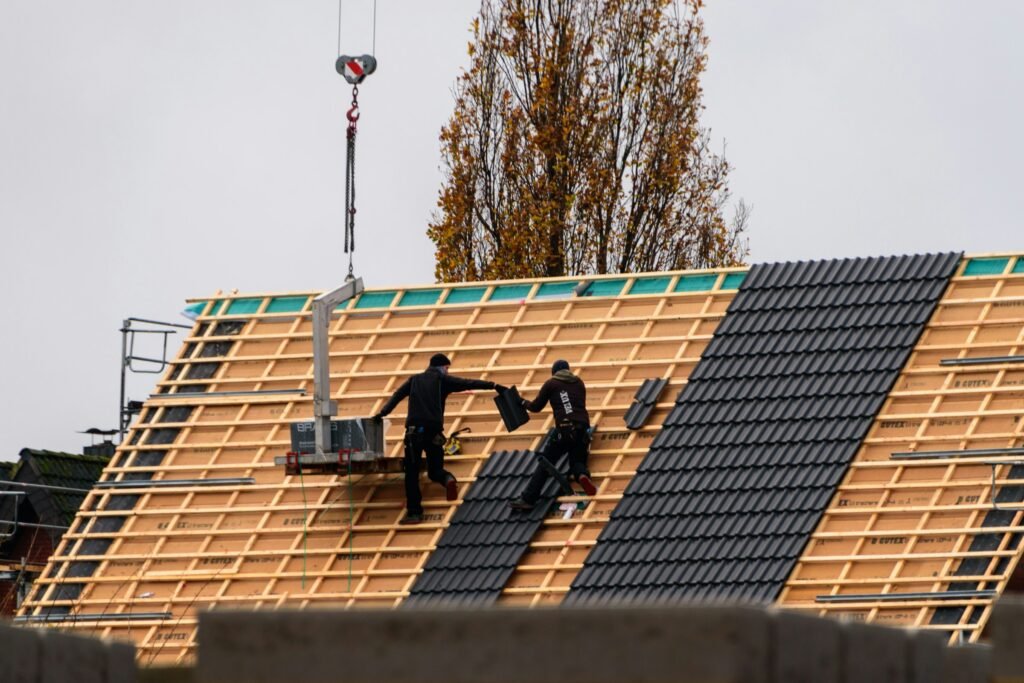
Day 2 — underlayment, flashing, install. Synthetic underlayment goes over the whole deck, with leak barrier in valleys and around penetrations. New drip edge, step flashing and pipe boots go in. Then the shingles, metal panels or tile go on to the manufacturer’s nailing pattern, with starter strips, hip and ridge caps, and ventilation components placed as they go.
Final day — cleanup and final inspection. A magnetic nail sweep of the entire yard and driveway, usually more than one pass. A final inspection from ground and roof level, and a walkthrough with you reviewing the completed work.
What it is like at home. You can stay home, but expect significant noise from around 7 AM to 6 PM, and the house will vibrate during tear-off. Remove fragile wall decorations and cover attic items with drop cloths. Your water and electricity stay on throughout. Many homeowners work from elsewhere on the first, loudest day. And in Cypress, Katy, The Woodlands and other HOA communities, confirm the approved shingle colour before ordering — otherwise the project can stall at the architectural committee.
Skylight + Re-Roof Timing
The most expensive skylight mistake in Houston is replacing the roof and leaving a 15-year-old skylight in it. A skylight and the roof around it age together, and the flashing that seals the skylight is woven into the shingles. Reflashing a skylight after a re-roof means disturbing the new shingles around the opening — and paying for the same opening a second time. Replacing the skylight during the re-roof means one job, one flashing, and a unit whose life starts with the roof’s.
- Roof being replaced and skylight under 10 years old, in good shape, no fogging, no frame leaks: keep it, and reflash it properly as part of the roof job.
- Roof being replaced and skylight 15 years or older, or fogged, cracked, or leaking at the frame: replace the unit with the roof.
See our skylight repair page for how to tell a flashing leak from a failed unit, and what each costs to fix.
What a Replacement Costs — The Short Version
The full cost breakdown — by material, by home size, what moves the price, and how to read a quote — is in our roof replacement cost guide. The short version, from published US national ranges: a typical architectural-shingle replacement runs roughly $8,000–$14,000 (about $4–$6 per square foot, tear-off included), or $350–$650 per roofing square — one square is 100 square feet of roof surface, measured on the slope, not off your floor plan. Metal runs roughly double that; tile roughly triple. These are published national ranges — not RoofDetect Pro’s prices and not Houston prices. What roof replacement Houston costs for your home comes from an inspection and a free written estimate.
Roof Replacement Cost in Houston — Angi’s Figures
The national ranges above are a starting point. Angi’s Houston-specific figures (updated August 1, 2026) put the average Houston replacement at $9,752, with most projects landing between $6,712 and $13,123. Per square foot, materials and labour run $4–$11, with an average of $4.65. These are published Houston guide figures from Angi — not RoofDetect Pro’s prices and not a quote. Your number comes from a free written estimate after an inspection.
Average cost by home size (Angi, Houston 2026)
| Home size | Average cost |
| 1,000 sq ft | $6,050 |
| 1,500 sq ft | $8,400 |
| 1,900 sq ft | $9,750 |
| 2,000 sq ft | $10,230 |
| 2,500 sq ft | $13,000 |
Average cost by material (Angi, Houston 2026)
| Material | Average cost |
| Asphalt shingles | $9,700 |
| Concrete/clay tile | $23,100 |
| Metal | $23,100 |
| Slate | $42,000 |
Two costs hide inside those averages. Removing the old roof runs $1,000–$3,000, and hidden water damage or decking replacement found during tear-off adds $500–$2,000 (Angi, Houston). That is why the per-sheet decking rate matters before you sign — nobody knows how many sheets are needed until the roof is open. The full breakdown — by material, by home size, what moves the price, and how to read a quote — is in our roof replacement cost guide.
Insurance: Storm Damage vs Wear
Whether insurance pays for a replacement depends on the same Texas rule as any roof repair claim: sudden and accidental damage is covered, wear and tear is not. The Texas Department of Insurance’s guide to insurance and your roof explains what to know when buying a policy or filing a claim.
Usually covered: hail damage across several slopes, wind tearing shingles off, a fallen tree. A full replacement is often covered when hail has damaged several slopes — which is common in Houston, where whole streets of 15-to-20-year-old roofs meet spring hail at the same time. After Hurricane Harvey in 2017 and Hurricane Beryl in July 2024, many homes in Katy, Cypress, Spring, The Woodlands, Sugar Land and Pearland needed exactly this kind of replacement.
Usually not covered: a roof that is simply old, granule loss from age, curling from years of heat, a leak that has been dripping for months while nobody looked. Those are maintenance and age.
Before you file: document the storm date and photograph the damage before anything is cleaned up, and do not start permanent repairs before the adjuster has seen the roof. Texas gives you one year from the date of loss to file. And on most Texas policies the wind and hail deductible is a percentage of the home’s insured value — typically 1% to 5% — so on a $300,000 home a 2% deductible is $6,000 out of pocket before insurance pays anything. If any contractor offers to waive, eat or pay your deductible, walk away — in Texas it is illegal for a contractor to pay, waive or rebate an insurance deductible (House Bill 2102), and it can put the whole claim at risk. See our storm damage page for the full claim steps.
What a Low Bid Leaves Out
A bid far below the published range usually leaves something out. Before you compare prices, check that every quote includes the same scope — and ask, in writing, what is excluded:
- The leak barrier in valleys and around penetrations — the layer that matters most, and the one most often skipped on a cheap quote.
- Synthetic underlayment across the whole deck — not felt paper, and not skipped.
- Ventilation — ridge vents or box vents sized for the attic. A new roof without ventilation is a roof that cooks from underneath.
- Flashing — new flashing at every valley, chimney, skylight, vent and wall joint, not old flashing reused.
- The decking rate — the per-sheet price for rotten decking found during tear-off. Ask it before you sign: it is the one line item most homeowners never think to check, and the most common place a quote grows after signing.
- The permit — a Houston roof permit typically runs $250–$500, and a TWIA windstorm certificate (WPI-8) may also be needed in windstorm areas. Ask whether the quote includes the permit and the inspection, or whether those are extra.
- Clean-up — including a magnetic nail sweep of the yard. A roof finished without one leaves nails in the grass and the driveway.
Compare like with like — the same shingle, the same underlayment, the same scope — or the cheapest quote wins by being the smallest job. Roof replacement Houston quotes that come in far below the rest are almost never a bargain; they are a shorter list of parts.
After the New Roof — The First Rain and the Next Storm
The crew leaves, the yard is swept, and the roof is yours. Three things are worth doing in the weeks after:
- Keep the paperwork. The contractor’s photos, the written scope, the invoice, the permit, and any warranty documents — in one place. If the same roof ever leaks again, or you sell the house, this record is what everyone works from.
- Check the attic after the first rain. Look for damp insulation or new stains once the new roof has faced a proper Houston downpour. A new roof should be dry inside; if anything is wet, call back with dated photos.
- Think about the next storm before it arrives. A new roof is the best time to get the pre-season check right — our hurricane preparation guide covers it — and a yearly maintenance check keeps the small issues small. See our roof maintenance page for what that visit covers.
FAQs
How do I know if I need a roof replacement or just a repair?
Three tests: the money test (a repair approaching a large share of a replacement quote, on a roof near the end of its life, means replace), the age test (under 15 years with local damage is usually a repair; over 15 with damage in more than one place is usually a replacement), and the stacking test (repairs that keep coming back mean the system is failing). GAF draws the same line in its repair-or-replace guide: small, localized damage is usually a repair; significant or widespread damage usually means a replacement.
How long does a roof replacement take in Houston?
A standard-pitch asphalt roof usually takes 1–3 days. Steep, large or cut-up roofs, tile and metal typically take 3–5 days. Decking repairs found during tear-off add time, and the crew schedules around weather forecasts to avoid rain interruptions.
How much does a roof replacement cost in Houston?
For roof replacement Houston homeowners, the published US national ranges put a typical architectural-shingle replacement at roughly $8,000–$14,000 ($4–$6 per square foot, tear-off included), or $350–$650 per roofing square. Metal runs roughly double; tile roughly triple. Those are national guide figures, not RoofDetect Pro’s prices. Angi’s Houston figures are higher than the national range in places — an average of $9,752, with most Houston projects at $6,712–$13,123 — and the Houston table is in the cost section above. The full breakdown is in our roof replacement cost guide, and your number comes from a free written estimate after an inspection.
Should I replace my skylight when I replace my roof?
If the unit is 15 years or older, fogged, cracked, or leaking at the frame — yes, replace it with the roof, or you will pay for the same opening a second time. If it is under 10 years old, in good shape and not fogged, keep it and reflash it properly as part of the roof job.
Can new shingles go over my old roof?
No — not on a proper Houston job. An overlay hides rotten decking, adds weight, traps attic heat, and most shingle manufacturers void the warranty on a re-roof over an existing layer. Texas allows at most two layers of shingles, and a full tear-off is the only way to know what the deck looks like before new material goes down.
Will insurance pay for a new roof?
If a storm caused the damage — hail, wind, or a fallen tree — often yes, minus your deductible (typically 1–5% of the insured value in Texas). If the roof is simply old or worn out, no. Texas gives you one year from the date of loss to file, and you should document the damage with dated photos before anything is cleaned up.
What is a roofing square?
One square is 100 square feet of roof surface, measured on the slope — not off your floor plan. A 2,000-square-foot house usually carries 2,200–2,800 square feet of roof once pitch and overhangs are counted, so the roof is bigger than the house. Architectural shingles run roughly $350–$650 per square installed in the published national ranges.
Do I need a permit to replace my roof in Houston?
Yes, usually — a Houston roof permit typically runs $250–$500, and a TWIA windstorm certificate (WPI-8) may also be needed in windstorm areas. Check whether your quote includes the permit or lists it separately.
Why is one quote much cheaper than the others?
Usually because something is excluded — the leak barrier, the underlayment, the ventilation, the flashing, the decking rate, the permit, or the magnet-sweep cleanup. Ask for an itemised written quote and compare the same scope, not just the bottom line.
Can I stay home during a roof replacement?
Yes. Expect significant noise from around 7 AM to 6 PM, and the house will vibrate during tear-off. Remove fragile wall decorations, cover attic items with drop cloths, and your water and electricity stay on throughout. Many homeowners work from elsewhere on the first, loudest day.
How long will my new roof last in Houston?
It depends on the material and the Houston heat. Standard 3-tab shingles rarely last beyond 18–22 years here; architectural shingles reach 25–30. Standing seam metal runs 40–70 years, clay or concrete tile 40–50, slate 75 years or more. Ventilation matters as much as material — trapped attic heat can halve a roof’s life.
Does a new roof raise my home’s value?
Usually, yes — Angi’s Houston figures put the average value added by a replacement at around $4,800. The bigger return is practical: a new roof removes the roof question from a sale entirely, where an old roof becomes a negotiation.
Can I replace just one slope of my roof?
Sometimes — if the damage is truly local to one slope and the rest of the roof has years left. But matching old shingles is hard, the new slope ages differently from the old ones, and a partial job can complicate warranties. When damage is widespread or the roof is near the end of its life, a full replacement is usually the better spend.
What happens to my old roof?
It comes off in the tear-off, down to bare decking, and is hauled away as part of the job — Angi’s Houston figures put old-roof removal at $1,000–$3,000. The crew tarps shrubs, pools and AC units first, and finishes with a magnetic nail sweep of the yard and driveway.
Which areas of Houston do you cover?
RoofDetect Pro connects homeowners across Houston, TX — including Katy, Cypress, Spring, The Woodlands, Sugar Land, Pearland, Tomball, Humble, League City, Missouri City, Pasadena, Jersey Village, Baytown and surrounding suburbs. Availability varies by ZIP code, time and service — call (831) 623-8078 to confirm. For example, our Tomball roof repair page covers replacement work in Tomball’s hail country in detail.