
Roof Repair in Houston, TX
Your roof is leaking, or a storm just tore shingles off it. If you need roof repair Houston TX homeowners can rely on, you need a repair — done properly, at the source of the problem.
RoofDetect Pro connects you with independent roofing contractors in Houston, TX for residential roof repair: leaks, missing and lifted shingles, flashing, pipe boots, valleys, ridge caps, gutters and decking. Tell us what’s wrong and we match you with a local contractor who inspects the roof, photographs the damage, and fixes it.
By RoofDetect Pro — Last updated: November 17, 2026
Call (831) 623-8078 — free roof inspection, no obligation.
Availability varies by ZIP code, time and service — call (831) 623-8078 to confirm. Weekend and holiday availability is not guaranteed everywhere.
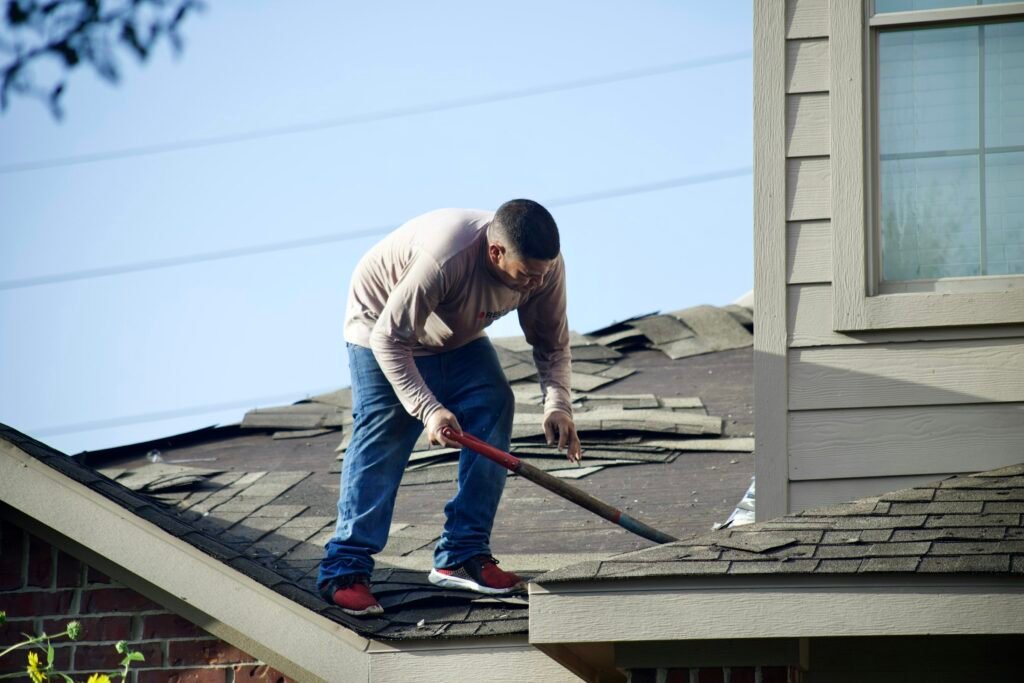
Roof repair is the core service of this site: it’s what most Houston homeowners need first. Houston’s rain, hail, hurricanes and heat break roofs at the weak points — and most of those are repairs, not replacements. Roof repair Houston TX covers everything from a single missing shingle to a full slope of storm damage, and this page covers residential roof repair Houston TX homeowners need most: when repair is the right call, the repairs themselves, how a visit works, what it costs, and how to decide between repair and replacement.
Roof Repair Houston TX — When Repair Is the Right Call
Repair is right when the problem is limited and the roof underneath is still sound. That’s the case more often than homeowners expect:
- The roof is under 15 — a younger roof with a leak in one place has years of life left.
- The damage is in one area — a few missing shingles, one failed pipe boot, one valley.
- The leak has one clear source the contractor can find and fix.
- The decking is sound — dry and solid. If it’s rotted, that’s a different job.
- The roof has been through one bad storm, not ten — one hail event causes repairable damage; a decade of storms is a different story.
Repair is the wrong call when the roof is over 20 years old, damage covers a large area, there are several leak areas, or the decking is rotted. That’s the replacement test — covered in full in the repair vs replacement decision guide below, and on the roof replacement page.
Repair is also faster: a leak doesn’t wait, and a repair can be done in a day while a replacement takes days of planning, permits and scheduling.
Common Houston Roof Repairs
These are the repairs Houston roofing contractors do most often. If your problem is on this list, it’s a repair a local contractor has done hundreds of times. Most roof repair Houston TX jobs start with one of these.
Missing, cracked and lifted shingles
Wind lifts shingle tabs and breaks their seals; hail cracks them and knocks granules off. A few missing shingles are a straightforward repair: replace the damaged shingles, re-seal the surrounding ones, check the underlayment. A whole slope of lifted tabs is different — that’s widespread damage, and it pushes toward replacement.
Flashing repairs
Flashing — the metal strips where the roof meets a chimney, wall, skylight or vent — is the most common leak source on Houston roofs. Heat expands and contracts it, wind works it loose, sealant dries out. Flashing repair means re-sealing or replacing it at the joint, not smearing caulk over the top. Most “mystery leaks” turn out to be flashing.
Pipe boots and vent seals
The rubber boot around a plumbing vent goes brittle in Houston heat. It’s one of the most common leak points in the city, and one of the cheapest to fix — a new boot, properly sealed, in under an hour. If your leak is near a bathroom or kitchen vent, check the boot first.
Valley repairs
Valleys carry the most water on a roof — two slopes draining into one channel. Pine needles and debris clog them, water backs up under the shingles, and the valley becomes a leak. Valley repair means clearing the channel, checking the valley flashing and underlayment, and replacing the shingles damaged by the backup.
Ridge caps
Ridge caps cover the peak, where wind hits hardest. Cracked or missing caps let wind-driven rain straight into the attic. Repair is quick work, but it needs the right caps for the roof — not cut-down field shingles.
Gutter and drainage repairs
Clogged or sagging gutters push water back onto the fascia and under the roof edge. Gutter repair — clearing, re-pitching, re-securing, sealing seams — protects the roof as much as the foundation. See the gutters page.
Decking repairs
Decking is the wood under the shingles. When a leak has gone on long enough, the decking rots — soft spots underfoot, or sagging between rafters. Small sections can be replaced as part of a repair; large areas of rot mean the roof has leaked for a long time, and that’s usually a replacement conversation.
Nail pops
Nails back out as decking expands and contracts with Houston’s heat and humidity, lifting the shingle above and opening a path for water. The fix is to remove the nail, re-fasten properly and seal the shingle — not to hammer it back down and hope.
Repair by Roof Type
A repair is not the same job on every roof — the material changes what fails and how it’s fixed.
Asphalt shingle roofs
Shingles are Houston’s most common roof, and the most repaired. Heat causes granule loss, curling and blistering; hail bruises the mat; wind lifts tabs. Shingle repair replaces the damaged shingles and checks the underlayment and flashing around them. The full picture is on the asphalt shingle page. Manufacturers such as GAF publish guidance on shingle types and how they are installed.
Metal roofs
Metal fails at the fasteners and the seams: screws back out, washers dry out, and thermal expansion works seams open over time. Metal repair means re-fastening, replacing washers, re-sealing seams, and checking for panel damage after hail — a job for a contractor who knows metal. See the metal roofing page.
Tile roofs
Clay and concrete tile last decades in Houston heat — but the underlayment underneath usually fails first. Tile repair is often really an underlayment repair: lift the tiles, replace the underlayment, re-lay the tiles, replace the cracked ones. Ridge and hip mortar also fails and needs re-pointing. See the tile roof repair page.
Flat and low-slope roofs
Flat roofs fail at ponding water, punctured membranes, failed seams and blocked drains. Repair means patching or re-welding the membrane and fixing the drainage — a roof that ponds for more than 48 hours after rain has a drainage problem, not just a leak. See the flat roof repair page.
How a Repair Visit Works
Here’s what happens before anyone climbs onto your roof, step by step:
- You call or send the form and describe the problem — a leak, storm damage, missing shingles, or just that you want an inspection. Call (831) 623-8078 or email info@roofrepairinstallation.com.
- We match you with an independent Houston roofing contractor — local, and doing the work. RoofDetect Pro is a referral service, not a crew.
- The contractor inspects the roof — exterior (shingles, flashing, ridge, gutters, soffit, fascia) and attic (ventilation, insulation, moisture, framing). For a leak, the inspection traces the entry point: the stain inside is almost never below the leak, because water travels along decking and rafters. How leaks are found is on the leak detection page.
- You see the evidence: photos of what’s damaged and written options — repair, or replacement if repair no longer makes sense. The contractor explains what they found in plain language.
- You decide — no pressure, no obligation. If it’s a repair, the contractor fixes it at the entry point, not just the stain inside.
- The fix is verified. The contractor checks the work, and a follow-up after the next rain is the real test.
That verification step matters — a repair that isn’t verified is a guess.
Repair vs Replacement — The Honest Decision Guide
This is the decision that costs Houston homeowners the most when it’s made wrong — in both directions. A replacement you didn’t need wastes thousands; a repair on a finished roof wastes hundreds and leaves the same leak next storm. Here’s the honest test:
| Factor | Repair usually wins | Replacement usually wins |
|---|---|---|
| Roof age | Under 15 years | Over 20 years |
| Damage extent | One area, one slope | More than ~25% of the roof, or several slopes |
| Leak count | One leak, one clear source | Several leaks in different places |
| Decking | Dry and solid | Rotted or sagging in multiple places |
| Granule loss | Minor, localised | Widespread — gutters full of granules |
| Repair cost | Well below replacement cost | Repair estimate approaching replacement cost |
| Storm history | One bad storm | A decade of hail and hurricanes |
The rule of thumb: if the roof is young and the damage is local, repair it. If the roof is old and the damage is everywhere, replace it. In between — a 15-to-20-year-old roof with moderate damage — the inspection photos decide, and a contractor recommending replacement should be able to show you why, in photos.
Published guidance lines up with this: HomeGuide’s roof repair cost guide (February 2026) notes that replacement is generally favoured when a roof is over 20 years old, a repair estimate tops $3,000, or damage covers more than 25% of the roof. The full replacement picture — process, materials, permits — is on the roof replacement page. For how repairs should be done, see the roofing guidelines from the National Roofing Contractors Association.
Roof Repair Cost in Houston — What to Expect
Let’s be straight: we don’t have a price list, and we won’t invent one. What we can give you is what published US national cost guides report, so you can tell whether a quote is in a normal range. Your actual quote comes from the contractor’s inspection of your roof.
The HomeGuide ranges below are published US national ranges, not Houston prices and not RoofDetect Pro’s prices — Houston quotes can be higher or lower depending on roof size, pitch, height, material and access. The Angi table after the list is Angi data for roof repair cost in Houston.
- Minor repairs — $150 to $1,000 (HomeGuide, February 2026): a small leak, a few missing shingles, a vent boot, caulking and sealing. Most roofers charge a $150 to $300 minimum call-out fee, so even a small job lands near that floor.
- Moderate repairs — $1,000 to $3,000 (HomeGuide): larger shingle sections, flashing work, leaks with some water damage, a small underlayment section.
- Major repairs — $3,000 to $6,000 or more (HomeGuide): shingles across multiple areas, structural leaks, skylight replacement, decking replacement. At this level, replacement starts to make sense — see the decision guide above.
- Leak repair specifically — $150 to $1,000 for a minor leak caught early, $1,000 to $6,000+ when it has caused water damage (HomeGuide).
- Common individual fixes (HomeGuide): vent boot $75 to $150; missing shingles $100 to $300 (up to 25) or $350 to $1,000 per 100 square feet; flashing $200 to $500; sagging roof $1,000 to $5,000.
- Angi data for roof repair in Houston: $395 to $1,971, with an average of $1,176.
| Roof repair cost in Houston | Angi data |
| Typical range | $395–$1,971 |
| Average | $1,176 |
What drives the price up: steep pitch, height, difficult access, tile or slate instead of shingles, wet insulation or rotted decking underneath, and water damage inside the house — a separate job from the roof repair itself.
Ask for the repair scope in writing, what’s included (materials, labour, clean-up), and whether the call-out fee is credited toward the work. A free inspection with photos tells you what the job actually is before any money changes hands. Cost questions in more depth are on the leak repair page and the replacement page.
Houston Climate: Why Repairs Fail Here
Houston damages roofs in specific ways. Understanding them tells you what to watch for:
- Heat: summer attic temperatures climb far above the air outside. Heat dries out sealant, makes rubber pipe boots brittle, and ages shingles from both sides.
- Humidity: near-95% summer humidity means condensation in a poorly ventilated attic — which looks like a leak but isn’t one. The leak detection page covers that question, because fixing condensation as if it were a leak wastes money.
- Hail: spring hail on the I-10 corridor bruises shingles (soft spots you feel, not holes you see), dents soft metal and strips granules. Hail damage is often invisible from the ground — that’s why a post-storm inspection matters.
- Hurricanes and derechos: Harvey (2017), Beryl (July 2024) and the May 2024 derecho (winds near 100 mph) lifted shingle tabs and broke their seals. Wind damage is often hidden: a tab looks fine from the ground but its seal is broken, and the next rain finds it.
- Rain volume: more than 50 inches a year means every weakness gets tested repeatedly — a small flashing gap that would survive a dry year becomes a leak here within a season.
The consequence: a Houston roof needs an inspection after every major storm and at least once a year.
Hail and Wind Damage — Roof Repair Houston TX After a Storm
Most Houston roof repairs start with weather. Hail bruises shingles and dents metal; wind lifts tabs, breaks seals and drives rain under the roof edge. The damage is often invisible from the ground — a roof can look fine from the street while the shingles above are bruised and the flashing below them is bent. That is why a roof repair Houston TX homeowners request after a storm starts with an inspection, not a guess.
Hail damage: what it does and how it is repaired
Hail hits a shingle roof in four ways: bruising (soft spots you feel with a hand, not holes you see), granule loss that leaves the shingle surface thin and patchy, cracked or split shingles, and dents in metal flashing, vents and gutters. Bruised shingles lose granules faster and age early; cracked shingles leak at the next rain. Repair means replacing the damaged shingles and any bent flashing — not sealing over them. When hail has hit most of a slope, or the roof is already old, the contractor will say so, and the decision guide above applies.
Wind damage: what it does and how it is repaired
Wind damage is usually a seal failure before it is a shingle failure: tabs lift, their seals break, ridge caps go missing and shingles crease where they flexed. Wind-driven rain then gets in through flashing gaps and under lifted tabs — which is why a roof can leak only in heavy rain and look dry the rest of the time. Repair means re-sealing or replacing the lifted tabs, replacing missing ridge caps, re-sealing flashing, and checking the attic for wet insulation or stained decking. The May 2024 derecho, with winds near 100 mph, lifted shingle tabs and tore off ridge caps across Houston.
After any storm, the sequence is the same: a free inspection, photos of the damage, and a written scope before any work starts. Do not sign anything on the doorstep — after a big storm, out-of-town crews go door to door in Houston, and a local contractor with a Houston address is the safer choice. The questions below cover what hail damage looks like and how to tell a storm chaser from a local roofer.
Maintenance That Prevents the Next Repair
Most roof repairs are preventable. What actually matters in Houston:
- Clear valleys and gutters twice a year, and after every big storm — pine needles and debris clog them, water backs up, and a clogged valley becomes a leak.
- Check pipe boots from the ground with binoculars — rubber boots go brittle in Houston heat, and a cracked boot is a repair before it becomes a leak.
- Trim overhanging branches — they scrape shingles in wind, drop debris into valleys, and give animals a path onto the roof.
- Look at the attic after rain: daylight through the decking, wet insulation, stains on rafters — all visible from inside, all early warnings. If you see any, get an inspection.
- Don’t walk on the roof yourself — foot traffic cracks shingles and tiles, especially in heat.
- Inspect after every major storm — hail and wind damage are often invisible from the ground, and a free inspection is the cheapest insurance a roof gets.
The full annual checklist is on the roof maintenance page.
A repair that only holds until the next rain is not a repair
In public Houston reviews, homeowners describe the same pattern: a leak “fixed”, then the first heavy rain brings the water back — and the contractor stops answering. A leak repair should name the entry point it fixed (flashing, vent boot, valley, shingle) so the next rain is a test of that fix, not a surprise.
What Houston homeowners say they want most is a call back
Public reviews of Houston-area roofers repeat the same complaint more than any other: the contractor promised to return, then went quiet. Before any work starts, agree in writing what will be done, when, and how you will be contacted — and do not pay in full before the work is finished, as the Texas Department of Insurance advises.
What a Houston roof repair usually costs — and what moves the number
Angi’s Houston guide puts the average roof repair at $1,002, with most homeowners paying $485–$1,535, and leak repairs at $360–$1,550. The two biggest cost factors Angi names are the type of damage and the square footage needing repair — which is why a written scope, not a verbal estimate, is what protects both sides.
The cheapest quote is not cheap if the leak comes back
Public reviews repeat the same ending: a reasonable price, a leak that was never corrected, and a contractor who stopped answering calls — including calls from the homeowner’s insurer. A written scope, photos of what was found, and a final payment only after the work is done are the protections the Texas Department of Insurance itself recommends.
Frequently Asked Questions
How much does roof repair cost in Houston?
There is no single price — it depends on the damage. Published US national ranges (HomeGuide, February 2026) put minor repairs at $150–$1,000, moderate at $1,000–$3,000, and major at $3,000–$6,000+. Those are national ranges, not Houston prices and not RoofDetect Pro’s prices. Your quote comes from the contractor’s inspection. Angi data for roof repair in Houston gives a typical range of $395–$1,971, with an average of $1,176 — see the table in the cost section above.
How long does a roof repair take?
Most repairs are done in a day — often a few hours. Inspection and repair are sometimes the same visit, sometimes separate. A repair needing decking replacement takes longer. That is typical for roof repair Houston TX jobs — most are done in a day.
Can you repair a roof in the rain?
No — not properly. Sealants and adhesives need a dry surface to bond. In active rain, the right move is a tarp to stop the water, then the repair once the roof dries — see emergency roof repair.
My roof leaks only when it rains hard. Is that urgent?
Yes. A leak that only shows in heavy rain is still a leak, and every storm makes it worse — wet insulation, stained ceilings and rotted decking. Get it inspected before the next storm.
Do I need a permit for a roof repair in Houston?
Minor repairs generally don’t need a permit; a full replacement does, and the contractor handles filing it. Permit rules are the city’s, not ours.
How do I know if I need repair or replacement?
Age, extent and decking: under 15 with localised damage usually means repair; over 20 with widespread damage usually means replacement. The full test is in the decision guide above, and a free inspection with photos settles it.
Do you repair flat roofs?
Yes — flat roof repair covers TPO, PVC, modified bitumen and built-up systems: ponding water, membrane punctures, seam failure and drains.
Do you repair tile and metal roofs?
Yes. Tile repair is usually an underlayment repair plus cracked tiles; metal repair is fasteners, seams and thermal expansion — both different skills from shingle repair.
Will my insurance cover the repair?
It depends on the cause and your policy: storm damage is usually covered, wear and age usually aren’t. The contractor documents the damage, which is what a claim needs — see the storm damage page. For what a home policy covers and how a claim works, see the Texas Department of Insurance.
What areas do you cover?
Houston and 17 surrounding suburbs — Katy, Cypress, Spring, The Woodlands, Sugar Land, Pearland, Tomball, Humble, League City, Missouri City, Pasadena, Baytown, Jersey Village, Hockley, Hedwig Village, Copperfield and Klein. Availability varies by ZIP code, time and service — call (831) 623-8078 to confirm.
How does RoofDetect Pro work?
RoofDetect Pro is a referral service: you call or send the form, we match you with an independent Houston roofing contractor, and the contractor inspects, quotes and does the work. We don’t do the roofing ourselves.
Is the inspection really free?
Yes — the contractor inspects your roof, photographs what they find, and gives you written options and a quote. There’s no charge for the inspection itself and no obligation to go ahead.
What does hail damage look like on a shingle roof?
Often, nothing you can see from the ground. Hail bruises shingles — soft spots you feel with a hand — knocks granules off, and can crack or split shingles. Metal flashing, vents and gutters show dents. Granules in the gutters after a storm are a clue. The reliable check is an inspection: the contractor walks the roof, feels for bruising, and photographs what they find.
Are shingle granules in my gutters a problem?
A few granules are normal — shingles shed some over time, and more after a hail storm. A gutter full of granules, or granules washing out of the downspouts after every rain, means the shingle surface is wearing thin. Localised loss can be repaired; widespread loss across the roof is a sign the roof is near the end of its life, and the repair-versus-replacement guide above applies.
How do I avoid storm-chasing roofers after a Houston storm?
After a big storm, out-of-town crews go door to door in Houston. Choose a local contractor with a Houston address and phone number, get the repair scope in writing before any work starts, and do not sign anything on the doorstep or pay a large sum up front. The contractor should inspect the roof, photograph the damage and give you written options — that is the process described above.
Do roofers need a licence in Texas?
Texas does not issue a state licence specifically for roofing contractors, so there is no state licence number to check. What matters instead is a local contractor you can reach, a written scope of work, photos of the damage, and a clear statement of what the repair includes — the same things the repair visit above is built around.
How long will a roof repair last?
It depends on the roof, not just the repair. A repair on a roof under 15 years old with sound decking can last for years — the new shingles, flashing or pipe boot simply become part of a healthy roof. On a roof over 20 years old, a repair is a bridge: it stops the leak now, but the roof is near the end of its life and the next failure is likely close behind. That is why the inspection matters — it tells you whether you are buying years or buying time.
RoofDetect Pro — Roof Repair in Houston, TX
13909 Mandolin Dr, Houston, TX 77070 · (831) 623-8078 · info@roofrepairinstallation.com
RoofDetect Pro is a referral service. Work is done by independent Houston roofing contractors.
Cost figures on this page come from the HomeGuide roof repair cost guide (February 2026) and the Angi roof repair cost guide. The HomeGuide ranges are published US national ranges; the table above is Angi data for roof repair cost in Houston. They are not RoofDetect Pro’s prices.