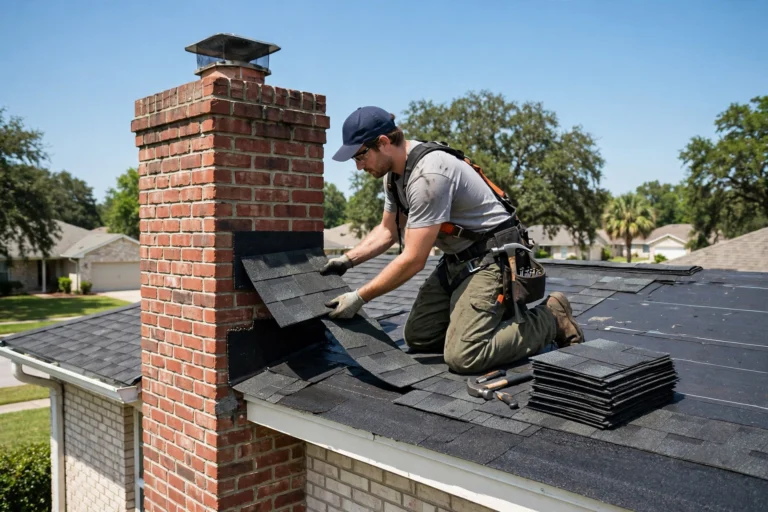
How to Find a Roof Leak in Houston, TX (and When to Call a Pro)
The brown stain on your ceiling is not where your roof is leaking. It is where the water finally gave up and came through — and by then it may have travelled several feet from the hole that let it in.
That is why so many Houston homeowners patch the shingles above a stain and watch it come back after the next big rain. Water gets through the roof at one point, runs along the underside of the decking or a rafter, and only drops when it hits a nail tip, a seam or a low point — then spreads across the top of your drywall and comes through somewhere else entirely.
Most leaks can be found in an afternoon without getting on the roof at all, if you look in the right order. This guide shows you that order — and where to stop and call a professional. This is how to find a roof leak houston tx, step by step, starting in the attic.
Call (831) 623-8078 — free roof inspection and written estimate, no obligation.
Availability varies by ZIP code, time and service — call (831) 623-8078 to confirm. Weekend and holiday availability is not guaranteed everywhere.

First: Is It Even a Roof Leak?
Before you go into the attic, one question sorts roof leaks from everything else.
Does it get wet when it rains — and only when it rains?
If the stain grows during or right after rain, it is almost certainly the roof. If it appears on a clear, hot afternoon with no rain for days, something inside your attic is making water.
In Houston, the usual suspect is your air conditioner. Most Houston homes have the air handler in the attic, and on a hot, humid day it pulls a remarkable amount of water out of the air — up to 50 gallons, by home-inspector guidance. That water drains through a condensate line; when the line clogs, the drain pan overflows and water comes through the ceiling in exactly the same place a roof leak would show. The tell: water dripping from the small pipe stub under your eaves means the secondary drain is working because the primary line is blocked — an AC problem, and a roofer cannot fix it.
Other impostors: a bathroom fan venting into the attic, and a plumbing leak in a wall cavity.
What You Need — and the Houston Attic Warning
You need a bright flashlight (not your phone), your phone for photos, something to kneel on, and chalk or a marker.
One Houston-specific warning: a Houston attic in summer can reach 130°F or more. Go early in the morning, keep the trip short, take water, tell someone you are going up, and come back down if you feel dizzy. Step only on the joists, never on the drywall ceiling below you — and if there is no safe floor, do not go in at all.
Do not climb onto the roof — not when it is wet, not when it is steep. Everything here can be done from the attic, from the ground with binoculars, or from a ladder at the eaves.
Step 1: The Attic — Twice
The attic is where leaks are found; the roof is where they are confirmed. Start inside — safer, faster, and the underside of your decking keeps a record the top of your roof does not. Learning how to find a roof leak houston tx starts here, in the attic — not on the roof.
Go up twice, on two different days:
- Once on a bright, sunny day. Turn the flashlight off, let your eyes adjust, and look for pinpricks of daylight through the deck, around every pipe, vent and flashing. If you can see out, water can find its way in. (Daylight at vents is normal.)
- Once during or right after a hard rain, when the water is actually moving.
Start above the ceiling stain and work outward. Look for dark staining on the underside of the sheathing, rusty nail tips (note where they cluster), wet or clumped insulation, and soft or swollen decking (touch it gently — soft wood means rot).
Mark everything. Circle each stain, rusty nail cluster and damp spot with chalk, and photograph each one with a rafter or vent in frame. You are building a map.
One caution: a dry stain is not proof of a fixed leak, and a wet stain is not proof of an active one. That is why inspectors use a moisture meter.
Step 2: How to Find a Roof Leak Houston TX by Tracing the Water Uphill
Water runs downhill along the underside of the deck until it hits a nail, a seam or a brace — then it drips. So trace every stain upward along the slope to its highest point. The highest damp spot is usually closest to the entry point. On a low-slope roof the entry may be a few feet from the stain; on a steep roof, considerably more. Once the highest damp point is marked, you know where to look outside — above it, and everything uphill of it.
Step 3: Check the Roof in Order of Likelihood
Now go outside — from the ground with binoculars, or from a ladder at the eaves. Leaks almost never happen in the middle of a field of shingles; they happen where something interrupts the roof — anything cut through it or joined to it.
- Pipe boots — check these first. In Houston this is the most common leak we hear about. A pipe boot is the rubber collar sealing your plumbing vent stacks, and Houston sun bakes the neoprene until it splits — usually in year eight to twelve. Look for a split collar or a gap between rubber and pipe.
- Flashing. Where the roof meets a wall or chimney, metal does the waterproofing, not shingles. It fails when sealant dries and shrinks, fasteners back out, or old flashing was reused instead of replaced. Look for separation, daylight, or cracked caulk at the joint.
- Valleys. Where two roof planes meet, the valley carries more water than anything else on the roof. Debris collects there, holds moisture, and dams water back under the shingle edges. Clear it and check the cuts — on an older roof the granules wear first in the valley.
- Vents and skylights. Turbine vents, box vents, ridge vent ends, exhaust caps, skylights — anything cut into the roof has a seam, and seams fail before shingles do. Skylights leak at the flashing far more often than at the glass.
- Fasteners and anything bolted on. A nail backs out, lifts the shingle above it, and there is a path — and so is anything screwed into the roof after the fact: satellite mounts, solar attachments, old antenna brackets.
- The shingles themselves — last. When shingles are the problem it is usually not one bad shingle; the roof has aged out across the whole plane — see our roof repair page for when repair still makes sense.
Flat or low-slope section (addition, porch, garage)? Different rules: flat roofs hold water rather than shedding it, so a leak usually means ponding, a failed seam or a blocked drain. See our flat roof repair page — water still standing two days after rain is a problem, not a puddle.
Step 4: The Hose Test — When You Still Cannot See It
If the attic map and the outside check have not settled how to find a roof leak houston tx, try the hose test. Two people and a garden hose: one on the ground or a ladder with the hose, one in the attic with a flashlight and a phone.
- Start low and work up. Begin at the bottom edge below the suspect area — start at the ridge and you soak everything below it.
- One small area at a time. One pipe boot. One section of valley. One side of the chimney.
- Be patient. Five to ten minutes per spot — real leaks take several minutes to make it through the deck.
- Talk to each other. The attic person calls it the moment anything appears — then stop the water and mark the spot.
Two hours of this finds most leaks a visual inspection missed.
While It Is Actively Leaking
If water is coming through right now, do these in order:
- Photograph it before you touch anything. Undocumented damage is a harder insurance claim.
- Move what you can and get a container under it.
- If the ceiling is bulging, relieve it. A sagging bubble full of water will eventually let go and take a larger piece of ceiling with it. A small hole with a bucket under it puts you in control.
- Stay off the roof — a wet roof is genuinely dangerous, and tarping in an active storm is how people get hurt. If it needs a tarp, that is a job for somebody with the right equipment on a dry day — see our emergency roof repair page.
When to Stop Looking and Call a Pro
Call it when the roof is steep, wet or high, or you are not confident on a ladder. That is not caution — that is the correct decision.
Call it when the water test has come up empty twice — you are likely dealing with a non-roof source, or a wind-driven leak that only appears in a real storm.
Call it when you find multiple entry points, or when you find it. Two or more separate leaks is usually a sign about the roof’s overall condition, and fixing even one pipe boot properly still means getting on the roof, pulling shingles, and reinstalling them so the repair sheds water instead of trapping it.
A professional inspection does what homeowner checks cannot: a thermal camera sees trapped moisture behind drywall and under decking, and a moisture meter tells a wet stain from a dry one. See our roof leak detection page and our roof inspection page. A typical leak repair in the US runs $400–$1,500 (typical $700–$1,100) in published national ranges — not our prices. The expensive part is the damage a leak does while nobody is looking.
Write Down What You Found
Before you call anyone, spend five minutes turning your afternoon into a record: the date, the weather, whether it correlates with rain or heat, what you inspected and ruled out — plus the attic photos.
It makes the roofer’s visit faster, and it gives you something to check the diagnosis against: if you found a split pipe boot above your marked stain and the roofer recommends a full replacement without mentioning the boot, ask why. And if it ever becomes an insurance matter, a dated record is what a carrier wants: most Texas policies cover sudden and accidental water damage, not gradual leaks, and Texas gives you one year from the date of loss to file.
FAQs
Why is the stain never directly under the leak?
Because water runs sideways twice: first along the underside of the deck or a rafter until it finds a nail or a seam to drop through, then across the top of your ceiling drywall until it finds a seam or a light fixture to come through. On a low-slope roof the entry point may be a few feet away; on a steep roof it can be considerably more.
How do I tell a roof leak from an AC leak?
Ask whether it correlates with rain. If the stain grows during or right after rain, it is the roof. If it appears on a clear, hot afternoon, check the AC condensate line — most Houston homes have the air handler in the attic, and a clogged drain line overflows the pan and drips through the ceiling in exactly the same place. Water dripping from the small pipe stub under your eaves means the secondary drain is working because the primary line is blocked.
Can I find a leak without going into the attic?
Partly. You can check the roof from the ground — pipe boots, flashing, valleys, skylights — with binoculars, and you can run a hose test from a ladder. But the attic is where you trace the water to its source, and without it, how to find a roof leak houston tx becomes guesswork at the entry point. If the attic is finished, has spray foam on the underside of the deck, or you cannot safely access it, skip straight to a professional inspection — foam-covered decks hide every visual clue.
What if the hose test finds nothing?
Run it twice, on different days, and be patient — five to ten minutes per spot, one feature at a time. If it still finds nothing, you are likely dealing with a non-roof source (AC, plumbing, condensation) or a wind-driven leak that only appears in a real storm. Both need different tools — a thermal camera and a moisture meter — and that is the point to call a pro.
Does homeowners insurance cover a roof leak?
Most Texas policies cover sudden and accidental water damage — a storm tears flashing loose, water comes in, you act fast. They usually will not cover damage from a gradual leak that went unrepaired for months. Document everything (photos, dates, what you did), mitigate the damage, and remember Texas gives you one year from the date of loss to file. Our storm damage page covers the claim steps in full.
How long can I wait before a small leak gets expensive?
Not long. A leak that shows as a small stain has often been running for weeks, and water in the deck and insulation does not stop on its own. Wet insulation loses its insulating value, damp decking rots, and mould follows moisture. A single pipe boot is one of the cheapest repairs on a roof; a rotted deck section is not. If the stain is growing after rain, get it looked at this week.