
Soffit and Fascia in Houston, TX
The fascia is the vertical board along your roof’s edge that your gutters hang from. The soffit is the paneling underneath the overhang that lets air into your attic. When either one fails, water and pests get in — and the damage spreads from the edge of the roof into the roof itself.
By RoofDetect Pro — Last updated: November 17, 2026
For soffit and fascia Houston repairs, the first question is never which material to use. It is how far the water has travelled. A peeling paint strip on the fascia is usually the first visible stage of rot. A gap in the soffit is usually an open door for squirrels. And a vent painted shut is usually why the attic runs hot enough to bake the shingles from below. The eave is one system — fascia, soffit, gutters and attic ventilation — and it fails as one system.
Call (831) 623-8078 — free roof inspection and written estimate, no obligation.
Availability varies by ZIP code, time and service — call (831) 623-8078 to confirm. Weekend and holiday availability is not guaranteed everywhere.
What Soffit and Fascia Actually Are
Most homeowners can point at both parts of the roof edge but cannot name either one. Here is the plain version.
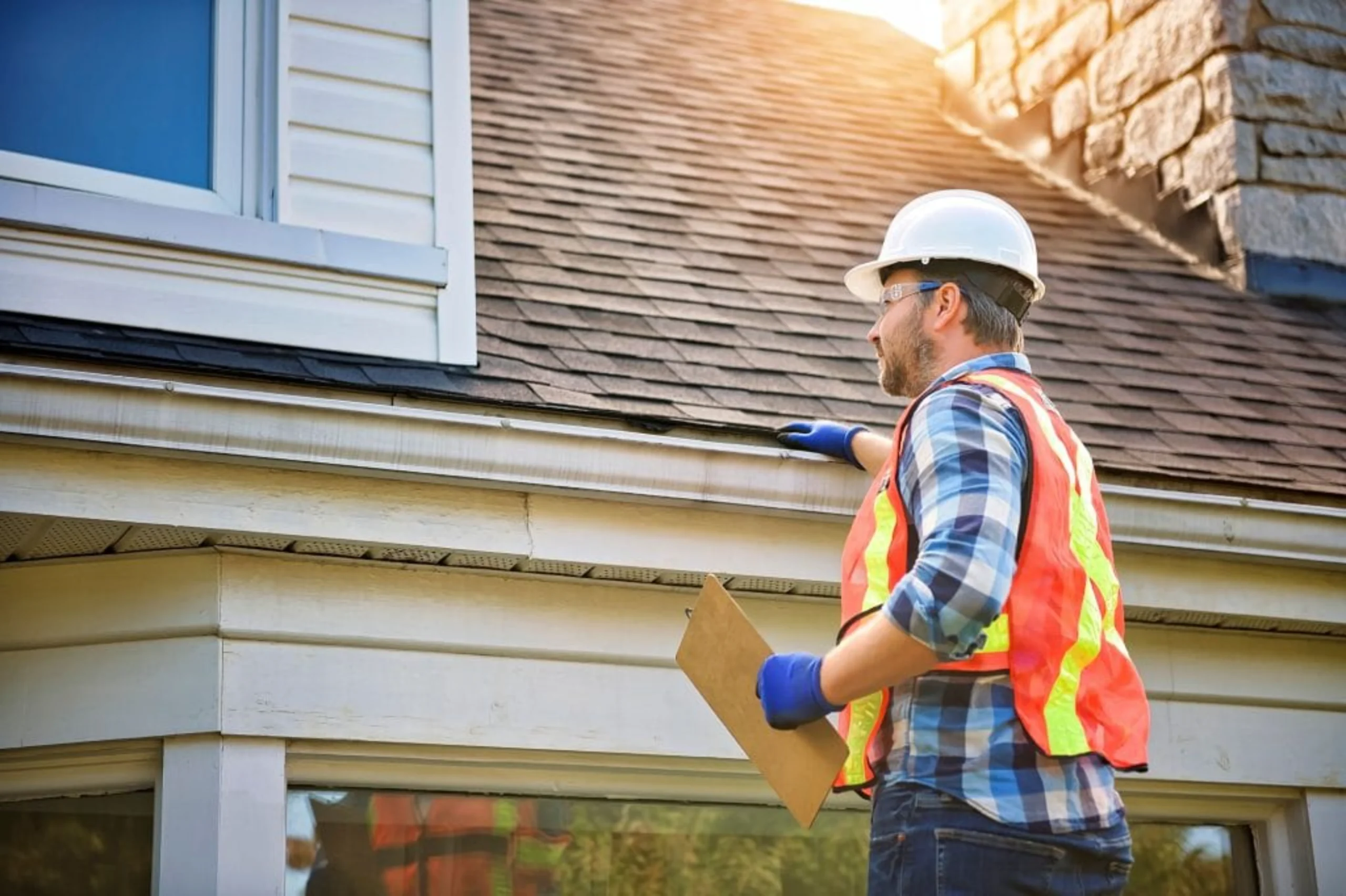
The fascia is the vertical board running along the lower edge of the roof, at the ends of the rafters. It does three jobs: it gives the roof edge a clean, finished look; it carries the gutters — every gutter hanger anchors into the fascia board; and it stands between the weather and the wooden ends of the roof structure. It is the most exposed piece of wood on the house, and it takes the worst of Houston rain, sun and hail.
The soffit is the paneling underneath the roof overhang, running from the exterior wall out to the fascia. Its job is less obvious and more important: most soffit panels are vented, with small holes that let outside air flow into the attic. That intake air is the start of the attic’s ventilation system — cool air comes in at the soffit, rises through the attic, and leaves at the ridge or gable vent. Without it, the attic cannot breathe.
They work as a pair, and they fail as a pair. Rot in the fascia leaves the soffit with nothing solid to anchor to, and a blocked soffit vent chokes the attic’s air supply. That is why the eave is checked as one system — and why a repair that fixes only the board you can see, and not the water that caused it, fails again in the same place.
6 Signs Your Soffit or Fascia Needs Repair
These are the six signs soffit and fascia Houston inspections find most often. Any one of them is worth a look from a ladder; two or more together mean the eave needs work soon.
1. Peeling or bubbling paint on the eaves. Paint fails for a reason, and on a roof edge that reason is usually moisture getting behind it. When the fascia board cannot dry out, paint lifts, bubbles and flakes in strips. It looks cosmetic from the ground. It is usually the first visible stage of rot.
2. Soft, crumbling or warped wood. Press gently on a suspect spot with a screwdriver handle. Sound wood resists. Rotted wood gives, crumbles at the edge, or feels spongy. On fascia, rot concentrates around gutter seams and end caps, where water sits longest. On soffit, soft spots mean the panel has been wet from above or from behind — and the framing behind it may be wet too.
3. Water stains under the eaves. Brown ring stains on the soffit, or staining where the soffit meets the wall, mean water is travelling somewhere it should not — usually a gutter overflowing behind the fascia, a clogged downspout, or a valley dumping runoff past the eave. The stain is below the leak, not at it. Our roof leak detection page explains how that tracing works.
4. Pests in the attic. Squirrels, rats and wasps enter through the path of least resistance, and a gap in the soffit is exactly that. If you hear scratching overhead, or see insects streaming in and out of a vent hole, something up there has an opening that belongs on a repair list. A gap the width of a finger is enough for a wasp nest; a gap the width of a thumb is enough for a squirrel.
5. Sagging, loose or missing sections. Soffit panels bow inward, pull loose or drop out when the framing behind them rots or the fasteners let go. Gutters that pull away usually point to the same problem: the fascia they are anchored to no longer holds a screw. Re-hanging gutters on rotted fascia holds until the next heavy rain.
6. A hot, stuffy attic and climbing cooling bills. Vented soffit is where attic airflow begins, and when it is blocked, painted over or damaged, the whole system underperforms. The attic runs hot, the air conditioner runs longer, and the shingles above age faster. If the upstairs rooms got noticeably warmer this summer, the intake side is worth checking before the air conditioner is blamed.
What Causes Soffit and Fascia Damage in Houston
Water does most of the damage, and the Gulf Coast supplies it in every form — then the humidity makes sure nothing dries out between soakings.
Clogged or overflowing gutters are the usual starting point. When a gutter clogs, water has nowhere to go but over the back edge — straight down the face of the fascia board and behind it. When a downspout clogs, the whole run backs up. The fascia sits wet for days after every storm, and in Houston humidity it never fully dries. That is the rot cycle: wet, never dry, wet again.
Humidity itself is the second cause. Houston air stays humid most of the year, and wood at the roof edge never gets the dry spell it needs to recover. Once paint cracks, moisture gets behind it and stays there.
Hail dents metal and aluminum soffit and bruises wood, opening small wounds that water finds later. A hailstorm that leaves the shingles looking fine can still have dented every soffit panel on one side of the house. See our storm damage page for what hail does to a roof, and our signs you need roof repair after a Houston storm guide for what storm damage looks like.
Sun and heat cycling warp panels and break down caulk at the joints. Vinyl soffit panels expand in Houston heat and pop out of their J-channel, leaving gaps wide enough for wasps, squirrels and bats. Wood fascia dries, shrinks and splits in the same heat.
Animals chew or pry at vents to get into the attic — and once one animal has opened a gap, the next one uses the same hole.
Age is the last cause, because no material at the roof edge lasts forever. Wood fascia on a 20-year-old Houston home has been through twenty summers of heat and twenty hurricane seasons of rain. At some point the question stops being whether it needs work and becomes how much of it.
Soffit Ventilation and the Attic — the Job You Cannot See
The most important job the soffit does is the one nobody sees: it feeds air into the attic. Vented soffit panels are the intake side of the attic’s ventilation system. Cool outside air enters through the soffit vents, rises through the attic, and leaves through the ridge or gable vent at the top — carrying heat and moisture out with it. Soffit and fascia Houston roofs depend on that intake working, because a Houston attic in summer is one of the hottest places in the house.
When the intake fails, the damage is quiet and expensive. A soffit vent painted shut stops the airflow at the eave. Insulation blown or laid over the vents does the same thing from the inside, and debris packed into the vents does it over time. The attic then runs hot, the air conditioner runs longer, and the shingles above bake from the underside. Moisture has nowhere to go either: warm, humid air rises into the attic, condenses on the deck, and the damp attacks the roof from below. Most roofs replaced for premature aging have an eave story in their history: rot, blocked vents, or both.
The U.S. government’s energy guidance is blunt about it. ENERGY STAR’s attic-ventilation guide warns homeowners never to cover attic soffit vents with insulation, and to use rafter vents — also called insulation baffles — to keep a clear channel for outside air to move into the attic at the soffits and out through the ridge vent. The ENERGY STAR attic-ventilation guide explains the same system this page describes: intake at the soffit, exhaust at the ridge, and nothing blocking the path between them.
That is why a soffit repair is never just a panel swap. The vents have to be open, not painted shut and not packed with debris — and the insulation in the attic has to stop short of the eave, with rafter vents holding it back. A crew that replaces soffit panels without checking the vents has fixed the look and left the problem.
Pests and Birds Through Damaged Soffit
A damaged soffit is an open door, and Houston has no shortage of animals looking for one. Squirrels chew through soft, rotted soffit to nest in the attic. Rats follow the same gaps. Wasps build nests in the sheltered space behind a loose panel. Birds nest in the eave itself, and their droppings and nesting material block the vents they sit behind.
The damage is rarely limited to the hole the pest came through. Squirrels and rats chew wiring and insulation in the attic, and their droppings contaminate the insulation. Wasps make the eave unusable for anyone who needs to work on it. And once an opening exists, it gets used again — by the next animal, and the next, until the gap is closed properly.
Closing the gap is only half the repair. The other half is fixing what let the animal in: the rot that softened the panel, the fastener that let go, the vent screen that tore. A patch over a rotted soffit is a patch the next squirrel chews through. The repair has to close the opening and restore the panel to solid wood or metal behind it — and the vent screens have to be intact, because a vent without a screen is an invitation, not a vent.
If you hear scratching overhead at dawn or dusk, or see birds or insects going in and out of the same spot on the eave, do not wait for the next storm to decide. The animals are already inside, and every week they are there is more insulation and wiring damaged.
Materials: Wood vs Aluminum vs Vinyl
The material question matters, because the right material for a Houston eave is the one that survives Houston humidity — and the three common choices do not survive it equally.
| Material | Rot | Paint / upkeep | Houston fit |
|---|---|---|---|
| Wood | Rots — needs paint to survive | Needs repainting on the same cycle as the rest of the exterior | Repairs cleanly in small sections; the original look on older homes |
| Aluminum | Does not rot | Painted or pre-finished; holds up | Best for fascia — shrugs off humidity, holds gutters firmly |
| Vinyl | Does not rot | Paint-free; colour is in the material | Best for soffit — light, vented panels, no painting; can pop loose in extreme heat |
Wood is the traditional material and still the right choice for a small repair that has to match the rest of the house. It cuts cleanly, takes paint, and a single rotted board can be replaced without touching the rest of the run. Its weakness is the one Houston exploits: it rots, and it only survives if the paint stays intact.
Aluminum is the workhorse for fascia. It does not rot, it holds a screw firmly enough to carry a full gutter in a storm, and it shrugs off the humidity that eats wood. It dents in hail where wood would bruise — a cosmetic difference, but a real one on the most visible board on the house. Most soffit and fascia Houston replacements move toward aluminum, and for good reason.
Vinyl is the standard for soffit. It does not rot, it never needs painting, and vented vinyl panels are made for the job — the ventilation holes are built in, not drilled. Its weakness is heat: vinyl expands in Houston summers, and panels installed tight can pop out of their J-channel, leaving the gaps pests use. Installed with room to expand, it lasts.
The honest comparison depends on how much of the edge is involved. A single rotted wood board gets a wood replacement, matched and painted. A whole run of failing wood gets aluminum or vinyl — because replacing wood with wood on a Houston eave is replacing a problem with the same problem, five years later.
Repair or Replace?
For soffit and fascia Houston homeowners, the repair-or-replace call comes down to how far the damage has spread — not how bad the worst spot looks.
Spot repair makes sense when the damage is genuinely local. One panel knocked loose by wind. One fascia run with a gutter seam leak. One section of peeling paint with sound wood beneath it. The rot stops, the material matches, and the repair disappears. It is also the right call when the rest of the run is sound and the material is aluminum or vinyl — those systems are made to have a section swapped out.
Replace the run — or the whole eave — when:
- Rot appears in more than a few isolated spots along the same run. If three boards are soft, the fourth is close behind.
- The existing material is old wood and the rest of the run is close behind it. Replacing one board at a time on a 20-year-old wood eave is paying for the same job four times.
- You are re-roofing or replacing gutters anyway, and the edge is exposed. The fascia and soffit are accessible during a re-roof in a way they never are again — and a new roof over a rotted eave is a new roof with an old weakness. See our roof replacement cost guide for what a re-roof costs and what a low bid leaves out.
- Pest entry points keep reappearing despite patching. If the gaps keep coming back, the material behind them has failed, and patching is treating the symptom.
A real eave inspection happens from the ladder, not the driveway: paint failure and staining on each run, suspect wood pressed, gutter mounts checked, and soffit vents confirmed open rather than painted shut or packed with debris. From the attic side, a flashlight at the eave shows daylight where it belongs and gaps where it does not. Our roof inspection page covers what a full inspection checks — and the eave is part of it.
Painting vs Replacement — the Honest Line
Paint is protection, not repair — and the line between the two is the line most eave jobs get wrong.
Paint is the right answer when the wood beneath it is sound. A fresh coat on solid fascia seals the wood against moisture and sun, and it is the cheapest maintenance the eave gets. New fascia boards should be painted — or, for aluminum and vinyl, pre-finished — because the finish is what stands between the material and the weather. Painted well, wood fascia lasts years longer than painted badly.
Paint is the wrong answer when the wood beneath it is rotted. Painting over rot does not stop rot. It hides it, traps the moisture inside, and lets the decay continue behind a surface that looks fine — until the board fails and takes the gutter with it. If a screwdriver sinks into the wood, no paint will save it. The rotted section has to come out first, and only then does paint make sense.
The same rule applies to soffit. A sound soffit panel, cleaned and painted, is a finished job. A soft soffit panel, painted over, is a problem with a fresh coat on it. Any quote that offers to paint the eaves without pressing the wood first is a quote for cosmetics, not a repair.
The Gutter Connection
The fascia and the gutters are one system, and they fail together. Gutter hangers anchor into the fascia board, which is why a sagging gutter line often means the fascia behind it is soft — and why re-hanging gutters on rotted fascia holds only until the next heavy rain.
It works the other way too. A clogged gutter is the most common cause of fascia rot in Houston: water overflows the back edge and runs down the face of the board, or sits behind it, for days after every storm. A gutter that pulls away dumps its water in one stream onto the fascia and soffit below it. In each case the gutter is the cause and the fascia is the casualty — and fixing the fascia without fixing the gutter means the new board rots the same way the old one did.
That is why a soffit and fascia job always includes the gutters in the inspection: are they clogged, are they pitched right, do the hangers hold? Gutter cleaning where clogged gutters are the root cause is part of the repair, not an extra. And if the gutters themselves are failing — seams leaking, sections sagging, hangers pulling out — the gutter work and the fascia work happen together, because neither one holds without the other.
The gutter page covers gutters in full. For this page, the rule is simple: if the gutters are the problem, say so, and fix them with the fascia — not after it.
What Soffit and Fascia Repair Costs
What soffit and fascia Houston repair costs depends on how much of the eave is involved, how high it is, what material is already there, and whether the rot has spread past the boards into the rafter tails. These are published US national ranges — not RoofDetect Pro’s prices and not Houston prices. Your written estimate is what your job costs.
| Job | Published US national range |
|---|---|
| Spot repair (small section) | $300–$1,000 |
| Fascia replacement | $5–$12 / linear ft (HomeGuide); $7–$22 / linear ft (Angi) |
| Soffit replacement | $4–$22 / linear ft (HomeGuide) |
| Combined soffit + fascia (full eave) | $9–$34 / linear ft (HomeGuide) |
| Full-perimeter replacement | $900–$6,800 (HomeGuide) |
| Dry-rot repair | $500–$4,000 (Angi) |
| Typical project total | $600–$6,000; national average $3,300 (Angi) |
Ranges: Angi, updated Oct 29, 2026; HomeGuide, 2026. Angi puts the overall range at $300–$7,200, with most homeowners paying $600–$6,000 and a national average of $3,300. Both guides agree on the shape of the pricing: a small spot repair is a few hundred dollars, a single side of the house is $600–$1,800, and a full eave on a two-story home with rot is several thousand.
What pushes a job up the range: height (a two-story eave costs more than a one-story eave); rot that has spread (rotted rafter tails or decking turn a board replacement into structural carpentry — Angi puts dry-rot work at $500–$4,000 on its own); material (wood fascia $1–$3 per linear foot in materials, vinyl $5–$8, aluminum $8–$20 — Angi 2026); and gutter work (if the gutters have to come off and go back on, that is part of the job).
Get the written estimate before the work starts, and check that it names the job — spot repair, run replacement, or full eave — and the material, so you know what you are paying for. A quote that just says “fix eaves” is not an estimate.
Insurance: Storm Damage vs Wear
Whether insurance pays for soffit and fascia work depends on the same Texas rule as any roof repair claim: sudden and accidental damage is covered, wear and tear is not. The Texas Department of Insurance’s guide to insurance and your roof explains what to know when buying a policy or filing a claim.
Usually covered: a soffit panel torn off by wind; fascia split by a fallen branch; hail damage to the eave; rain that enters through storm damage. Document the storm date and photograph the damage before anything is cleaned up — the same evidence rule as any storm claim. See our storm damage page for the claim steps. After Hurricane Harvey in 2017 and Hurricane Beryl in July 2024, homes in Katy, Cypress, Spring, The Woodlands, Sugar Land and Pearland needed exactly this kind of eave repair.
Usually not covered: fascia rotted by years of overflowing gutters; soffit softened by long-term moisture; paint peeling from age and sun; a gap that pests have used for years while nobody looked. Those are maintenance and age — the insurer’s answer is the same as for a worn-out roof.
The deductible question: on most Texas policies the wind and hail deductible is a percentage of the home’s insured value — typically 1% to 5%. A soffit repair that costs less than the deductible is not a claim at all; it is a repair you pay for. And if any contractor offers to waive, eat or pay your deductible, walk away — in Texas it is illegal for a contractor to pay, waive or rebate an insurance deductible (House Bill 2102), and it can put the whole claim at risk.
FAQs
What is the difference between soffit and fascia?
The fascia is the vertical board along the roof edge that gutters attach to. The soffit is the horizontal paneling under the overhang between the wall and the fascia, usually vented to feed air into the attic. They work as a pair at the eave — and they fail as a pair.
How do I know if my soffit or fascia needs repair?
Look for peeling or bubbling paint on the eaves, soft or crumbling wood, brown stains under the overhang, pests in the attic, sagging or missing sections, and a hot, stuffy attic with climbing cooling bills. Any one of these is worth a look from a ladder; two or more together mean the eave needs work soon.
How much does soffit and fascia repair cost?
For soffit and fascia Houston homeowners, the published US national ranges are: a spot repair $300–$1,000, fascia replacement $5–$12 per linear foot (HomeGuide) or $7–$22 (Angi), soffit replacement $4–$22 per linear foot, and a full-perimeter replacement $900–$6,800. The national average project is $3,300 (Angi, Oct 2026). Those are national guide figures, not RoofDetect Pro’s prices — your written estimate is what your job costs.
Can soffit and fascia be repaired, or do they need replacing?
A spot repair works when the damage is genuinely local — one panel knocked loose, one fascia run with a gutter seam leak, paint peeling over sound wood. Replace the run when rot appears in several spots, the material is old wood and the rest is close behind, or pest entry points keep reappearing despite patching.
Why is my attic so hot — is it the soffit?
Very possibly. Vented soffit is where attic airflow begins, and when the vents are blocked, painted shut or packed with debris, the whole system underperforms — the attic runs hot, the air conditioner runs longer, and the shingles above bake from the underside. ENERGY STAR’s guidance is blunt: never cover attic soffit vents with insulation.
What is the best material for soffit and fascia in Houston?
Aluminum for fascia — it does not rot, holds gutters firmly, and shrugs off Gulf humidity. Vinyl for soffit — it does not rot, never needs painting, and vented panels are made for the job. Wood is right for small repairs that must match the rest of the house, but it rots and needs repainting on the same cycle as the rest of the exterior.
Can I paint over damaged fascia instead of replacing it?
No. Paint protects sound wood; it does not fix rotted wood. Painting over rot hides it, traps moisture inside, and lets the decay continue behind a surface that looks fine — until the board fails and takes the gutter with it. If a screwdriver sinks into the wood, the rotted section has to come out first.
Will insurance cover rotted fascia?
Usually not. Fascia rotted by years of overflowing gutters or long-term moisture is wear and maintenance, which policies do not cover. Insurance usually covers sudden damage — a soffit panel torn off by wind, fascia split by a fallen branch, or hail damage to the eave. The dividing line is sudden damage versus wear and tear, the same rule as any Texas roof claim.
Should I replace my soffit and fascia when I replace my roof?
If the eave is rotted, blocked or pest-damaged — yes, replace it with the roof, because the edge is exposed during a re-roof in a way it never is again. If the soffit and fascia are sound, keep them and make sure the vents are open and the gutters are solid. A new roof over a rotted eave is a new roof with an old weakness.