
Metal Roofing in Houston, TX
For metal roofing Houston, a metal roof is a 40-to-70-year roof — if it is the right metal, the right gauge, and the right system for the roof it sits on.
By RoofDetect Pro — Last updated: November 17, 2026
For metal roofing Houston, the first question is not which metal. It is which system. A standing seam roof and an exposed-fastener roof are both “metal roofing”, and they are not the same product at all: one hides every fastener under a raised seam, the other puts a screw through the face of every panel. In Houston’s heat, UV and hail, that one difference decides whether the roof lasts 40 years or starts leaking at year ten. Everything on this page follows from it.
Call (831) 623-8078 — free roof inspection and written estimate, no obligation.
Availability varies by ZIP code, time and service — call (831) 623-8078 to confirm. Weekend and holiday availability is not guaranteed everywhere.
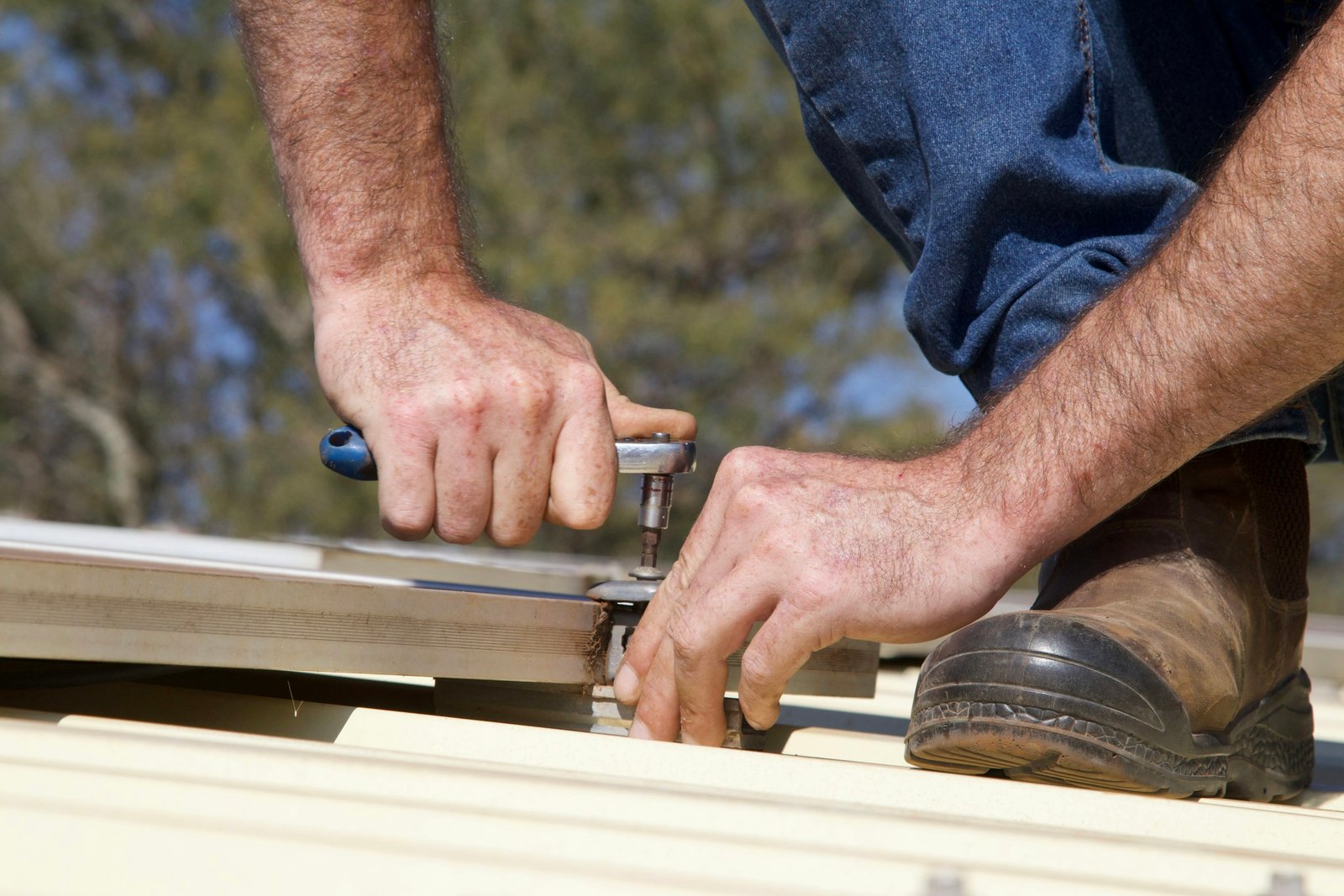
What Metal Roofing Is: Four Systems, One Name
“Metal roofing” covers four different products, and the price and the lifespan change completely between them.
| System | How it fastens | Published lifespan | Best for |
|---|---|---|---|
| Standing seam | Concealed clips under raised seams; no screws through the panel face | 40–70 years | Homes — the premium residential system |
| Exposed fastener (R-panel, corrugated, 5V crimp) | Screws with rubber washers through the panel face | 25–40 years | Barns, workshops, sheds, budget roofs |
| Metal shingle / metal tile | Interlocking panels that look like shingles or tile | 40–70 years | Homes where the look of shingles matters |
| Stone-coated steel (DECRA, Gerard) | Interlocking steel panels coated in stone granules | 40–70 years | Suburban homes where the HOA wants a traditional look |
| Copper / zinc | Standing seam in premium metals | 70+ years | Premium and historic homes |
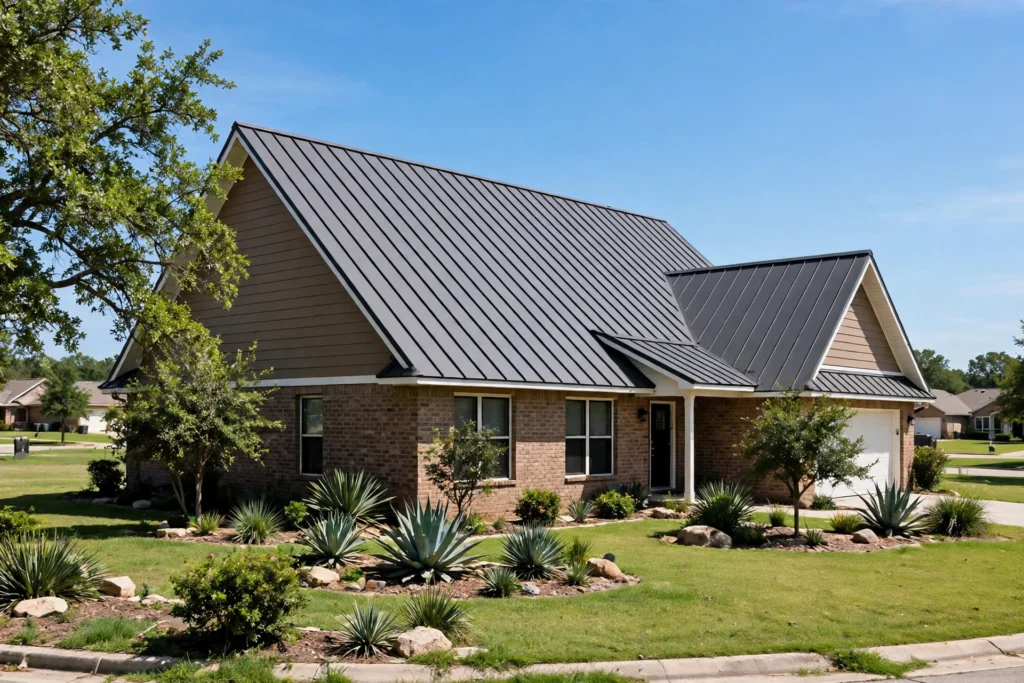
Standing seam is the system Houston homeowners mean when they say “metal roof” — and the default choice for metal roofing Houston. Long vertical panels run from ridge to eave, and each panel locks into the next along a raised seam. The fasteners are concealed clips that sit between the panels, under the seam — so no screw ever goes through the face of the roof. Panels are usually roll-formed on site to the exact length of the roof, so there are no end laps either.
Exposed fastener panels — R-panel, corrugated, 5V crimp — are screwed directly through the face of the metal into the deck, with a rubber washer under each screw head. They are cheaper and faster to install, and they are the right call for a barn, a workshop or a shed. On a house, every one of those screws is a future leak point.
Metal shingles and stone-coated steel are the compromise for homes where a standing seam roof would look wrong or the HOA requires a traditional appearance. They interlock like shingles or tile, they carry similar wind and impact performance to standing seam, and stone-coated steel costs less than standing seam. In suburban Houston, where HOA covenants often require a traditional roofline, they are the metal roof that actually gets approved.
Standing Seam vs Exposed Fastener — The Decision That Matters
Metal roofing Houston homes get is usually one of two systems, and the difference between them is not cosmetic. It is a leak, eight to twelve years from now.
An exposed-fastener roof has hundreds of screws through its face, and every screw has a rubber washer under its head. In Houston’s UV, those washers dry out, shrink and crack — and the usual life of a washer in this climate is 8 to 12 years. When a washer goes, the screw hole becomes a leak. The fix is a scheduled re-seal: every screw on the roof gets checked and re-torqued or re-washered, roughly every 15 to 20 years, and the roof’s life is set by how faithfully that maintenance happens.
A standing seam roof has no screws in its face at all. The panels are held by concealed clips, and the next panel locks down over the clip with a raised vertical seam. There is no water path to a fastener, no washer to degrade, and no scheduled re-seal. Just as important, the panels are free to “float” on their clips as they expand and contract with Houston’s heat — so they do not buckle or oil-can the way a rigidly fastened panel does.
There are three standing seam variants, and the pitch of your roof decides which one fits:
- Mechanical lock (double-lock). A seamer rolls the seam over twice, locking it mechanically. This is the system for low-slope roofs — anything that flattens below a 3:12 pitch, including additions, porte-cocheres and porches — and for the Texas windstorm area and commercial work. It is the most expensive standing seam variant, and the only one that belongs on a low slope.
- Snap lock. The male and female panel edges click together without a seaming tool. Faster to install and cheaper in labor, with strong wind performance — but it needs a minimum 3:12 pitch, because the seam is interlocked, not crimped, and water can theoretically migrate up an unsealed seam in extreme rain at lower pitches. This is the standard residential system for roofs at 4:12 pitch or steeper.
- Nail strip (fastener flange). A nailing flange runs along one edge of the panel, hidden under the overlap of the next. The fastener never touches the visible panel face, so it counts as concealed-fastener — but the leak path back to the fastener is shorter than on a mech-lock or snap-lock roof. It is the cheapest standing seam option, and it belongs on workshops, garages and budget retrofits, not on a main house.
If your roof is low-slope, say so before anyone quotes a system: a snap-lock roof on a 2:12 pitch is a leak waiting for the next Gulf storm. See our flat roof repair page for what low-slope roofs need.
Steel vs Aluminum — Decided by Where Your House Sits
Steel or aluminum is the second decision, and for metal roofing Houston the answer depends on where the house sits — not on which metal is “better” in general.
Galvalume steel is the value pick for most inland Houston homes. It is harder than aluminum, so it resists hail dents better, and it costs less. The standard residential spec is 24-gauge: the jump in dent resistance from 26-gauge to 24-gauge is non-linear at hailstone sizes of 1.0 to 1.5 inches, and the cost difference is small. 26-gauge belongs on outbuildings and budget projects with no hail history, not on a main house in the hail belt.
Aluminum never rusts — the substrate itself is immune to salt-air corrosion. That is why it is the safe choice near Galveston Bay and the coast, and on historic homes where its lighter weight (about half of steel) matters for an older structure. It costs more than steel, and it is softer, so it dents more easily in hail. Specifying aluminum for a hail-belt install in Cypress or The Woodlands is the wrong call; specifying steel within a few hundred feet of salt water is the wrong call the other way.
Both metals take the same factory finish — PVDF, sold as Kynar 500 — which resists fading and chalking far longer than standard polyester (SMP) finishes. In Houston’s UV, that finish is not an upgrade; it is the reason the roof still looks like a roof in twenty years. Cool-roof formulations of the same finish, with reflective pigments, bounce more solar heat off the roof than a dark shingle ever could.
Houston Decides the Roof: Wind, Hail and Heat
Three Houston conditions decide whether a metal roof earns its price, and a metal roof is the only common residential system that answers all three at once.
Wind. A standing seam assembly is engineered to the wind, not just rated for it. Tested assemblies carry a UL 580 Class 90 wind-uplift classification — the top pass/fail uplift class — and Houston’s design wind loads run roughly 130 to 140 mph ultimate under ASCE 7. The engineering is in the details: narrower panels put less load on each seam and clip, the clip and fastening schedule is tightened in the perimeter and corner zones where uplift is highest, thicker metal raises the tested uplift capacity, and the deck itself is re-fastened so the whole assembly — deck, clips and panel — resists uplift as one system. A panel is only as strong as what it is attached to.
Hail. Houston is a hail market — Texas records more major hail events than any other state — and hail is where metal earns its keep. Panels are available with a Class 4 impact rating, the highest rating under UL 2218, tested with a 2-inch steel ball dropped from 20 feet. Steel resists denting better than aluminum, and extreme hail may leave cosmetic dents on either metal — but the panel’s integrity, and its watertight seal, typically stays intact. That is the difference between a hailstorm that totals a shingle roof and one that leaves a metal roof dented and still dry. See our storm damage page for what hail does to a roof and how a claim works, and our signs you need roof repair after a Houston storm guide for what storm damage looks like.
Heat. A metal roof with a reflective PVDF finish bounces solar heat off the roof instead of absorbing it. Published guides put the reduction in attic heat gain and cooling loads at 15 to 25% against dark asphalt shingles — real money in a city that runs air conditioning nine to ten months a year. The Metal Roofing Alliance — the industry association for residential metal roofing — publishes the same point in its homeowner guidance: a properly constructed metal roof handles extreme heat with minimal maintenance, and reflective finishes are a large part of why.
Metal vs Shingle — The 50-Year Math
Most metal roofing Houston homeowners ask about starts with one question: is it worth twice the price of shingles? The honest answer is that it depends on how long you plan to stay — and the math is done over 50 years, not at the quote.
A standing seam roof costs roughly twice what architectural shingles cost, and it lasts roughly three times as long. Over 50 years, a homeowner with shingles replaces the roof two or three times. A homeowner with standing seam replaces it once. Here is that comparison using published US national ranges — not RoofDetect Pro’s prices and not Houston prices — for a 2,000-square-foot roof:
| Roof | Installed cost | How many in 50 years | 50-year total |
|---|---|---|---|
| Architectural shingles ($4–$6/sq ft) | $8,000–$12,000 | 2–3 | $16,000–$36,000 |
| Standing seam steel ($9–$16/sq ft) | $18,000–$32,000 | 1 | $18,000–$32,000 |
The totals overlap. On pure installation cost over 50 years, a standing seam roof can cost the same as — or less than — two or three shingle roofs, before any energy savings or any insurance discount is counted. That is the real comparison: not the quote, but the quote times how many times you pay it.
It is an investment that makes sense for homeowners who plan to stay ten years or more, or who want to add premium value before selling. It does not make sense for a roof you plan to leave behind in three years — the next owner gets the benefit, and you paid for it. And it does not make sense on a roof with a failing deck or saturated insulation underneath: a premium panel on a bad deck is a premium roof that fails early. See our roof replacement cost guide for what a re-roof costs and what a low bid leaves out.
The Noise Myth, and Oil-Canning
Two worries stop Houston homeowners from choosing metal, and both have honest answers.
“It will be loud in the rain.” No — not on a residential roof. A barn roof is loud because it is bare metal over open purlins, with nothing between the panel and the room below. A residential standing seam roof is installed over a solid deck and synthetic underlayment, which deaden the sound.
Most homeowners find it no louder than an asphalt shingle roof. If your quote skips the underlayment, that is the quote to question — the underlayment is part of the soundproofing, part of the waterproofing, and part of the roof.
“It will buckle and oil-can.” Oil-canning — the visible waviness in a flat metal panel — happens when a panel is fastened rigidly and has nowhere to go as it expands and contracts with temperature. Standing seam panels float on their clips, so they expand and contract freely instead of buckling. A panel that oil-cans badly was usually installed with the wrong clip spacing or fastened too tightly. It is an installation problem, not a metal problem — and it is one more reason the installer’s discipline matters more than the brand on the panel.
Repair vs Replace for a Metal Roof
A metal roof fails differently from a shingle roof, and the repair decision follows the failure.
Repair it when: the leak is at a flashing, a penetration or a seam — the places where a metal roof actually leaks, not the panel field. Flashing around a chimney, a skylight or a vent can be re-sealed or replaced without touching the panels. On an exposed-fastener roof, a leak at a screw is fixed by replacing the washer and re-torquing the screw — and if the roof is past 15 years old, a full screw-and-washer service across the whole roof is the honest fix, not a spot repair. A dented panel that still seals is a cosmetic problem, not a replacement. See our roof repair page for how leak repairs work, and our roof coatings page for the elastomeric coatings that seal an aging metal roof’s fasteners and seams.
Replace it when: the panels themselves have rusted through, the seams are opening across the whole roof, or the deck underneath has failed. A single rusted-through panel can be replaced; a roof where rust is showing up everywhere cannot be patched panel by panel. The same rule applies as with any roof: if the repair costs more than half of what a replacement would cost, replacement is usually the smarter move. Our roof inspection page covers what an inspection checks before that call is made.
Do not coat a shingle roof to save it, and do not patch a metal roof with shingles. The two systems do not mix, and a patch that mixes them is a leak with a delay on it.
What Metal Roofing Costs
What metal roofing Houston costs depends on the system, the gauge, the metal, the finish and the roof itself — and the published guides disagree with each other by a lot. That disagreement is itself the honest answer. Published US national guides quote the following installed ranges for 2026. These are published national ranges — not RoofDetect Pro’s prices and not Houston prices. Your written estimate is what your job costs.
| System | Published US national range |
|---|---|
| Standing seam, steel | $9–$16 / sq ft |
| Exposed fastener (R-panel / corrugated / 5V) | $4–$9 / sq ft |
| Metal shingle | $8–$11 / sq ft |
| Metal tile / stone-coated steel | $9–$13 / sq ft |
| Copper / zinc | Well above standing seam — premium metals |
| Architectural shingles (for comparison) | $4–$6 / sq ft |
Ranges: HomeGuide 2026, AIBuildCalc Sep 2026, Budget Roofing Oct 2026. HomeGuide’s overall 2026 figures put a metal roof at roughly $7,500–$40,000 for an average home. One national guide quotes standing seam as high as $14–$22 per square foot — the top end of that range is a complex roof in a high-cost market, not a typical Houston home. Five things push a quote from one end of the range to the other:
- System. Standing seam costs roughly twice what exposed fastener costs — concealed clips, longer panels, more labor. The system is the price.
- Gauge. 24-gauge steel costs more than 26-gauge, and the dent resistance it buys in Houston hail is worth more than the difference.
- Metal. Aluminum costs more than Galvalume steel, and copper or zinc cost far more than either.
- Finish. PVDF (Kynar 500) costs roughly 10–15% more than standard polyester (SMP) — and in Houston UV, it is the finish that still looks right in twenty years.
- Roof complexity. Valleys, dormers, chimneys and a steep pitch all add labor, and a tear-off adds cost on top of the panels.
Get the written estimate before the work starts, and check that it names the system, the gauge, the metal and the finish — so you know what you are paying for. A quote that just says “metal roof” is not an estimate. And check that it includes the tear-off, the underlayment, the flashing and the trim: on a metal roof, the trim and flashing are a large share of the job, and a quote that leaves them out
is not a complete quote.
What Metal Roofing Houston Costs by Home Size and Metal Type
For metal roofing Houston homeowners comparing systems, the Angi Houston metal roof cost guide — updated July 20, 2026 — puts the average metal roof in Houston at $10,995, with most homeowners seeing totals between $6,325 and $16,090 and the full range running from $1,200 to $22,000. Angi’s average is $11 per square foot, materials and labor included, so the size of the roof is the first thing that moves the total. Those are Angi’s Houston guide figures, not RoofDetect Pro’s prices and not a quote: your written estimate is what your job costs.
| Roof size | Angi Houston average |
|---|---|
| 100 sq ft | $1,100 |
| 500 sq ft | $5,500 |
| 1,000 sq ft | $11,000 |
| 2,000 sq ft | $24,200 |
Angi’s table lists 2,000 square feet at $24,200 because its text explains that a 1,950-square-foot home needs about 2,200 square feet of roof once pitch and overhang are counted. The metal itself is the second thing that moves the total. Angi’s Houston averages by metal type are $7,500 for aluminum, $11,000 for steel, $8,500 for tin, $9,000 for zinc and $25,000 for copper. By style, Angi lists corrugated at $6,000, metal shingles at $10,000 and standing seam at $11,000 on average — the most expensive style, and the one with the fewest seams that can leak in Houston’s above-average rainfall. That is the same trade the rest of this page describes: standing seam costs more because there is nothing to fail at a screw hole. See our roof repair cost guide for what a repair costs before a full re-roof is on the table, and our roof replacement page for what a complete re-roof involves.
Three smaller numbers sit on top of the panel price. Angi puts the labor to install a metal roof in Houston at an average of $5,500, and a Houston permit at an average of $67.51 — the City of Houston charges a base fee of $46.35 plus $5.29 per $1,000 of work above $7,000. Adding insulation under the metal adds $1,000 to $1,500, and Angi notes it can pay for itself in lower cooling bills over time. None of these are RoofDetect Pro’s prices; they are Angi’s published Houston figures, and they are the reason two quotes for the same roof can sit thousands of dollars apart.
Insurance: Class 4 Discounts, Storm Damage and the Deductible
Whether insurance pays for a metal roof depends on the same Texas rule as any roof repair claim: sudden and accidental damage is covered, wear and tear is not.
The Class 4 discount is real — and not automatic. If your roof’s panels carry a Class 4 impact rating, they may qualify you for an impact-resistant roof discount on your homeowner’s policy. Each Texas insurer sets its own discount and criteria, and some require their own form — the Texas Department of Insurance Form PC068 is the usual one. A Class 4 roof does not guarantee a discount; it makes you eligible to ask for one. Ask your agent what your insurer requires before you count the saving in the 50-year math.
Storm damage is covered; age is not. Hail that dents panels, wind that lifts a seam, or debris that punctures a panel in a storm is sudden damage, and it is usually covered. A roof that is simply old, a finish that has faded after decades in the sun, or washers that wore out after 15 years is wear and tear, and it is not. Document the storm date and photograph the damage before anything is cleaned up — the same evidence rule as any storm claim.
The deductible question: on most Texas policies the wind and hail deductible is a percentage of the home’s insured value — typically 1% to 5%. A metal roof repair that costs less than the deductible is not a claim at all; it is a repair you pay for. And if any contractor offers to waive, eat or pay your deductible, walk away — in Texas it is illegal for a contractor to pay, waive or rebate an insurance deductible (House Bill 2102), and it can put the whole claim at risk.
Metal Roofing Houston and the Cosmetic Damage Exclusion
The Class 4 discount in the section above has a second half that rarely comes up in a sales conversation. In Texas, the discount and a cosmetic damage exclusion can travel together. The Texas Department of Insurance adopted Endorsement HO-145, Exclusion of Cosmetic Damage to Roof Coverings Caused by Hail, in Commissioner’s Bulletin B-0030-98, effective May 2, 1998. Its operative line is one sentence: “We do not cover cosmetic loss or damage to roof coverings caused by the peril of hail.” Read the bulletin here: Texas Department of Insurance Bulletin B-0030-98.
The endorsement defines cosmetic damage as damage that alters the physical appearance of the roof covering but does not let water through it and does not stop the covering from doing its job of keeping out the elements. On metal roofing Houston homes, hail most often does exactly that: it dents panels that stay watertight. A roof can look hail-battered and still be excluded, because the dent is cosmetic under the endorsement’s definition. Hail that lets water in, or that makes the covering fail at keeping out the elements, stays covered.
Two limits matter. First, HO-145 may only be attached to a policy that is eligible for and receiving a premium credit for an impact-resistant covering — the same credit the Class 4 discount describes — so the exclusion and the discount arrive together. Second, the endorsement is void unless the insured signs it. Before a storm season, check the declarations page and the endorsement list on the policy, and ask the agent in writing whether taking the impact-resistant credit attaches a cosmetic damage exclusion. After a storm, a roof inspection documents which dents are cosmetic and which let water in — and a dent that lets water in is a roof repair, not a cosmetic question. For the higher build standard some Houston homeowners choose for wind and hail, see our FORTIFIED roofing page.
A dented metal roof that still keeps water out may not be covered
Texas has an optional endorsement, HO-145, that excludes cosmetic hail damage to roof coverings — but it can only be attached to a policy that is receiving a premium credit for an impact-resistant roof, and it is void unless the homeowner signed it. Before choosing metal, ask your insurer whether your policy carries a cosmetic hail exclusion.
FAQs
Is a metal roof worth it in Houston?
For metal roofing Houston homeowners who plan to stay ten years or more, usually yes: a standing seam roof lasts 40 to 70 years against 15 to 30 for shingles, it resists hail and wind that total shingle roofs, and over 50 years it can cost the same as two or three shingle roofs. For a roof you will leave behind in three years, the next owner gets the benefit and you paid for it.
Standing seam or exposed fastener — which should I choose?
Standing seam for a house, exposed fastener for a barn, workshop or shed. Standing seam hides every fastener under a raised seam, so there is no washer to degrade and no screw hole to leak. Exposed fastener is cheaper, but its rubber washers dry out in Houston UV in 8 to 12 years, and every screw becomes a future leak point that needs a scheduled re-seal.
Will a metal roof be loud in the rain?
No, not on a residential roof. A standing seam roof is installed over a solid deck and synthetic underlayment, which deaden the sound — most homeowners find it no louder than an asphalt shingle roof. A barn roof is loud because it is bare metal over open purlins, with nothing between the panel and the room below.
Does a metal roof attract lightning?
No. A metal roof does not attract lightning, and it is no more likely to be struck than a shingle roof. If lightning does strike, metal is non-combustible and disperses the charge — it will not catch fire the way some other materials can.
Steel or aluminum — which is better for Houston?
It depends on where the house sits. Galvalume steel is harder, resists hail dents better, and costs less — the right pick for most inland Houston homes. Aluminum never rusts, so it is the safe choice near Galveston Bay and the coast, and on older homes where its lighter weight matters. Both take the same PVDF finish.
How much does metal roofing cost?
For metal roofing Houston homeowners, the published US national ranges for 2026 are $9–$16 per square foot installed for standing seam steel, $4–$9 for exposed fastener panels, $8–$11 for metal shingles, and $9–$13 for metal tile or stone-coated steel. Those are national guide figures, not RoofDetect Pro’s prices — your written estimate is what your job costs.
How long does a metal roof last?
A standing seam roof lasts 40 to 70 years, and an exposed-fastener roof 25 to 40 years with screw-and-washer service every 15 to 20 years. Either one outlasts two to three shingle roofs. The panel is rarely what fails first — the flashing, the fasteners and the deck underneath it are.
Can a metal roof be repaired, or does it have to be replaced?
Most metal roof problems are repairs: a leak at a flashing, a penetration or a seam, or a failed washer on an exposed-fastener roof. A dented panel that still seals is cosmetic. Replacement is needed when panels have rusted through, seams are opening across the whole roof, or the deck underneath has failed.
Will insurance give me a discount for a metal roof?
Possibly. Panels with a Class 4 impact rating may qualify you for an impact-resistant roof discount, but each Texas insurer sets its own discount and criteria, and some require their own form (Texas Department of Insurance Form PC068). It is not automatic — ask your agent what your insurer requires before you count the saving.
Can a metal roof be installed over asphalt shingles in Houston?
Sometimes, if the deck is sound, there is only one layer, and local code allows it. But it hides the deck, so soft or rotted sheathing stays hidden, and moisture trapped between layers has nowhere to dry in Houston humidity. A tear-off is usually the honest call for metal roofing Houston homes, and an inspection decides which fits your roof.
How much does a metal roof cost for a 2,000-square-foot Houston home?
For metal roofing Houston homeowners, Angi’s Houston guide lists about $24,200 for a 2,000-square-foot roof at its $11 per square foot average, and a Houston average of $10,995, with most homeowners seeing $6,325 to $16,090. Metal, style, gauge and roof complexity move the number. Those are Angi’s figures, not a quote — your written estimate is what your job costs.
Will hail dents on my metal roof be covered by insurance?
Not always. A metal roofing Houston policy carrying TDI endorsement HO-145 excludes cosmetic hail damage: dents that only change the roof’s look are cosmetic, while damage that lets water in or stops the roof working stays covered. The exclusion can sit on a policy receiving an impact-resistant roof credit, so check the endorsement list and ask your agent in writing.
Will a metal roof rust in Houston’s humidity?
Galvalume steel resists rust through its coating, and aluminum never rusts, so the metal itself is not the weak point. Rust starts where the coating is cut, scratched or damaged, or where two different metals touch and react. For metal roofing Houston homes near Galveston Bay, salt air makes aluminum the safer pick, and steel needs its coating kept intact.
How often does a metal roof need maintenance in Houston?
Once or twice a year, clear leaves and pine needles from valleys and behind chimneys, check gutters drain, and look at penetration flashings and pipe-boot sealant, the shortest-lived part of the assembly. On an exposed-fastener roof, plan a screw-and-washer service every 15 to 20 years — that service is what keeps metal roofing Houston roofs dry past year fifteen.