
Roof Leak Repair in Houston, TX
The stain on your ceiling is almost never where the leak starts. That is why roof leak repair Houston TX work starts with tracing the water to its source, not patching the stain.
By RoofDetect Pro — Last updated: November 20, 2026
Water gets in through one small opening — a cracked pipe boot, a lifted piece of flashing, a valley that has stopped draining — and then travels along rafters, decking and insulation until it finds a weak spot in your ceiling and shows itself. That journey can be several feet, and it can cross from one side of the roof to the other. A repair that patches the stain fixes nothing. A repair that finds the entry point and fixes it there stops the leak.
RoofDetect Pro connects you with independent roofing contractors in Houston, TX for roof leak repair: the leak is traced to its source, fixed at the entry point, and checked again so you know it is dry. You get a free written estimate before any work starts, and a written report of what was found and what was fixed.
Call (831) 623-8078 — free leak inspection and written estimate, no obligation.
Availability varies by ZIP code, time and service — call (831) 623-8078 to confirm. Weekend and holiday availability is not guaranteed everywhere.
This page covers where Houston leaks actually start, how roof leak repair Houston TX traces a leak to its source, what each kind of repair involves, what a repair costs (published US national ranges, labelled — not our prices), when a leak means repair and when it means replacement, what insurance usually covers, and what to do in the first hour after you find water coming in. Houston is hard on roofs — 50+ inches of rain a year, 4–6 hail events a year, 95% summer humidity, and storms like Hurricane Beryl in July 2024 and the May 2024 derecho — which is why a small leak here is never worth ignoring for a season.
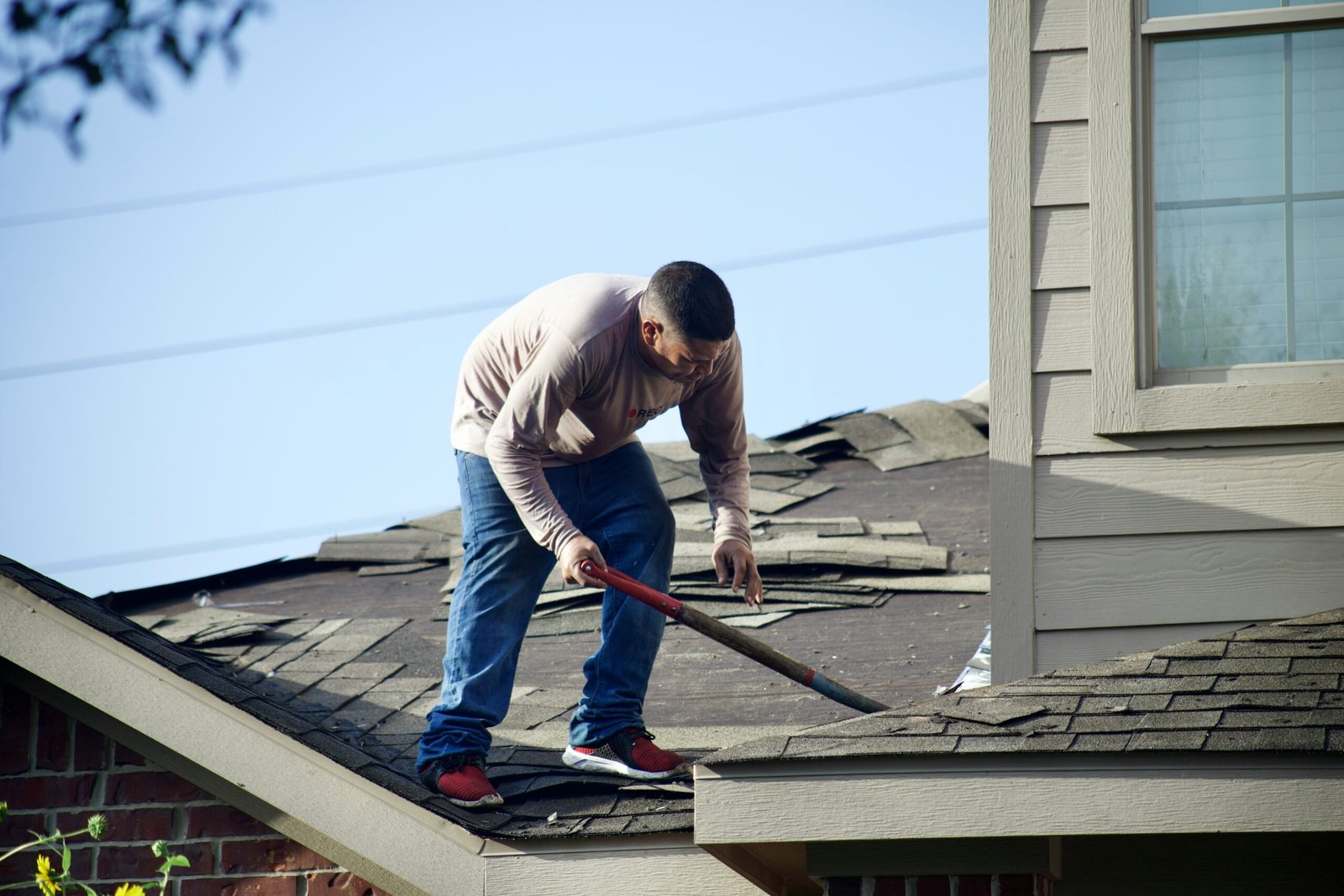
The Stain Is Not the Leak — Water Travels
This is the single most important thing to understand before anyone climbs onto your roof. Water does not fall straight down through a roof. It follows the path of least resistance: along the top of the decking, down a rafter, across insulation, until gravity and a seam in your ceiling let it through. The stain you see is where the water exited, not where it entered.
Three consequences follow from that:
- A patch over the stain is wasted money. Sealing the ceiling, or replacing the shingles directly above the stain, leaves the real entry point open. The next rain brings the water back, usually through the same stain.
- A small stain can hide a big problem. A leak that has been running quietly for months can rot several sheets of plywood decking and soak attic insulation while the ceiling shows only a faint brown ring. The size of the stain tells you almost nothing about the size of the damage underneath.
- Finding the source is the skilled part of the job. Anyone can replace a shingle. Tracing a leak means reading the roof — following water stains in the attic back uphill, checking every penetration and joint above the stain, and testing with water where the entry point is still unclear. That is what the inspection visit is for. See our roof inspection page for what the visit covers, and the leak detection page for the tracing methods in detail.
If a contractor offers to fix your leak without looking in the attic or walking the roof above the stain, they are guessing. Get a second opinion.
Where Houston Leaks Actually Start
Most Houston roof leaks come from a short list of failure points. Knowing the list helps you understand the quote — and helps you spot a contractor who is selling you a new roof for a $200 problem.
- Pipe boots — the most common leak on roofs over 10 years old. The rubber boot around a vent pipe sits in full Houston sun and heat, dries out, cracks, and lets water in around the pipe. It is a small fix and the single most common leak source Houston roofers report. If your roof is over ten years old and leaking, the pipe boots are the first place to look.
- Flashing — where the roof meets something else. The metal around chimneys, walls, skylights and valleys. Flashing corrodes, pulls away from the surface, or was never sealed properly — and in Houston’s humidity and heat, sealants degrade faster than in drier climates. Failed flashing is one of the most common leak sources in the city, and it is often invisible from the ground.
- Valleys — where two roof planes meet. All the water on your roof travels through the valleys, so they fail first and leak worst. Live oak and pine debris clogs them, standing water finds any weak point in the underlayment or metal, and a valley leak can soak a large area of decking before it shows inside.
- Nail pops and lifted shingles. Heat and wind work fasteners loose; a lifted shingle or a popped nail is an open hole in the roof, and wind-driven Gulf rain pushes water sideways into it. Hail bruising and granule loss do the same job more slowly — the shingle looks intact from the ground but no longer sheds water.
- Skylights and vents. The flashing and seals around a skylight, a roof vent or an attic fan are leak points of their own. A skylight leak is usually a flashing or seal failure, not a problem with the skylight itself — but it needs the skylight page‘s detail to fix properly.
- Chimneys and wall joints. Where a brick or stucco wall meets the roof, step flashing has to be fitted piece by piece. When it fails, water runs down the wall and into the house — and the stain often appears on a wall, not a ceiling, which sends people looking in the wrong place.
- Flat and low-slope sections. Seams, penetrations and ponding spots are where flat roofs leak. Water that has not drained 48 hours after rain turns a small puncture into a steady leak. See the flat roof repair page for how flat-roof leaks are handled.
Whatever the source, the repair follows the same order: trace it, fix it at the entry point, and verify it is dry. A repair that skips the first step is a guess.
How Roof Leak Repair Houston TX Traces a Leak to Its Source
A proper leak repair starts with finding, not fixing. The contractor works uphill from the stain:
- Inside first. The attic is checked where it can be reached safely — water stains on rafters and decking, damp insulation, daylight where there should not be any. The stain pattern in the attic usually points uphill toward the entry point. Our guide on how to find a roof leak walks through the same attic-first check.
- The roof above the stain. Every penetration, joint and flashing uphill from the stain is checked on foot: pipe boots, vents, flashing, valleys, lifted shingles, nail pops. Steep, fragile or multi-story sections may be checked by drone instead — the photos go into the same report.
- Instruments where eyes are not enough. Where it helps, the inspector may use a moisture meter or thermal imaging to check for damp below the surface. A leak that only shows up in heavy rain often needs this — the entry point is wet long before the ceiling is.
- Water testing, when the source is still unclear. Water is run over one suspect area at a time, starting low and working up, while someone watches inside. It is slow and methodical, and it is how a leak that has beaten two previous repairs finally gets found.
- The fix, then the check. The repair is made at the entry point — not at the stain — and the area is checked again at the next rain. If the old stain stays dry and no new damp appears, the leak is fixed. If anything is still wet, call with dated photos and where the water shows inside.
If an area cannot be reached safely, the report says so instead of guessing. A leak that cannot be traced from the surface or the accessible attic is not something a visual check can confirm — that is stated plainly, not smoothed over.
What a Leak Repair Includes
A leak repair visit, done properly, has four parts:
- Trace — find the entry point, as above, and show you the photos of it.
- Fix at the entry point — replace the failed part, not the area around it: a new pipe boot, re-sealed or replaced flashing, valley metal repaired, lifted shingles re-sealed or replaced, a puncture patched and sealed. The surrounding roofing is disturbed as little as possible.
- Check the damage the leak already caused — soft or sagging decking under the leak, wet insulation that has stopped insulating, stained drywall. Small areas of decking can be replaced as part of the repair; widespread rot changes the job from a repair to something bigger (see repair vs replacement below).
- Verify — the repair is water-tested where possible, and you are told what to watch for at the next rain. The written estimate covers the work that was actually found — no price is fixed on the phone, because the scope depends on what the roof shows.
Most leak repairs are completed in a single visit: a pipe boot or a few shingles take one to two hours, flashing repairs two to four hours, a valley repair up to a full day. Deck repairs run longer — one to three days if several sheets need replacing. The visit itself, with the trace and the written estimate, is free, with no obligation.
How Much Does Roof Leak Repair Cost?
RoofDetect Pro does not set prices — the contractor quotes the work in writing after inspecting it, because the scope depends on what was actually found. What follows is published US national ranges, labelled as national ranges: not Houston prices, and not RoofDetect Pro’s prices. Competitors’ own prices are not copied here — those are their prices, not ours.
Nationally, most homeowners pay between $400 and $1,500 for a roof leak repair, with a typical bill of around $700 to $1,100. Small, single-source leaks — a cracked pipe boot or a handful of blown-off shingles — sit at the low end of that range. Leaks that have soaked the decking, insulation or drywall push toward the top of it, and beyond, because each of those adds work. (Compare current US ranges at HomeGuide and Angi.)
What moves the price:
- Source and location — a leak at an easy-to-reach field shingle costs less than one buried in a valley, at a chimney, or behind a second-story wall.
- How far the water has travelled — surface repairs are inexpensive; rotted decking, soaked insulation and stained drywall each add trades and cost.
- Roof pitch and access — steep, tall or multi-story roofs need more safety equipment and labour.
- Roof material — asphalt shingles are quick and cheap to repair; tile, slate and metal need matched materials and specialised labour, and cost more.
- Roof age — an older, brittle roof is harder to repair without collateral damage, which nudges the cost up.
- Emergency timing — storm-season tarping and urgent calls carry a premium over a scheduled repair. Temporary tarping is a stop-gap, not the fix: it buys time to dry out, document damage for insurance, and schedule the real repair.
The cheapest leak repair is the early one. A leak caught at the first stain — before water reaches the plywood deck — is almost always a few-hundred-dollar fix. The same leak ignored for a season can rot decking, ruin attic insulation and stain drywall, turning a small repair into a multi-thousand-dollar project. That is the whole case for calling at the first sign, not the third.
Roof Leak Repair Cost by Repair Type
National ranges hide how much the repair type matters. The table below uses HomeYou’s Houston cost guide (2026) for the common leak repairs — these are published guide figures for Houston, not RoofDetect Pro’s prices and not a quote. The contractor still quotes your job in writing after inspecting it, because the scope depends on what the roof shows. For comparison, Angi’s Houston figures for roof repair overall run $395–$1,971 typical, with a $1,176 average.
| Repair | What it covers | HomeYou Houston guide |
|---|---|---|
| Leak inspection | Full roof + attic check to find the entry point | $82–$158 |
| Leak location service | Tracing a hidden leak with meters/thermal imaging | $145–$359 |
| Damaged shingle replacement | Replace blown-off or cracked shingles in the leak area | $228–$685 |
| Flashing leak sealing | Reseal or replace flashing at chimneys, walls and vents | $220–$647 |
| Roof valley leak repair | Repair valley metal/underlayment where water collects | $340–$870 |
| Roof puncture repair | Patch punctures from debris and fallen limbs | $192–$545 |
Our roof repair cost guide has the Houston figures in more detail.

Leak Repair vs Replacement — When Each Makes Sense
Not every leak means a new roof, and not every roof with a leak is worth repairing. Three things decide it: the roof’s age, how widespread the damage is, and whether the decking underneath is sound. As a rough guide used across the industry, if a repair costs a large share of a replacement quote, replacement usually wins on lifetime value — but that is a guide, not a rule, and it needs a real replacement quote to apply to your roof.
- Repair — the damage is local: one pipe boot, one flashing, one valley, a small area of shingles. The rest of the roof is in good shape, the decking is sound, and the roof has years left in it. A roof under ten years old with localised damage is almost always a repair.
- Watch and maintain — nothing is leaking yet, but there are minor issues to monitor: early granule loss, a boot starting to crack, a valley collecting debris. Cleaning, re-sealing and a re-check after the next storm are usually enough.
- Replacement — the problems are widespread or keep returning after repairs: shingles failing across whole slopes, underlayment worn out under sound-looking tile, decking soft in several places, or a roof past the age where repairs stop making sense. A roof over twenty years old with widespread damage is usually a replacement discussion, not a repair. A contractor who recommends replacement should be able to show you why, in photos.
The full decision guide is on the roof repair page — age, extent and decking, with the same three-way test. The leak repair is what gives you the evidence to use it.
Leak or Condensation? — The Houston Misdiagnosis
Not every damp patch in a Houston attic is a roof leak. In a city with 95% summer humidity, condensation can look exactly like a leak: damp insulation, water stains on decking, a musty smell, even drips. The difference matters, because sealing a roof will not fix condensation — and a leak left to be treated as condensation will rot the decking.
- A leak leaves a trail: stains that run downhill from one entry point, damp that appears during or just after rain, and a clear source on the roof above the stain.
- Condensation appears when warm, humid air meets a cold surface — usually where ventilation is poor and insulation is thin or wet. It shows up as general damp across a wide area, often with no rain at all, and no single entry point on the roof.
An inspection that checks ventilation and insulation alongside the roof surface can tell the two apart. If a previous contractor “fixed” your leak and the damp came back with no rain, ask for the attic ventilation and insulation to be checked before anyone sells you another repair.
When a Leak Is an Emergency
Most leaks can wait for a scheduled visit. Some cannot:
- Water is actively pouring in — a steady drip or stream during rain, a ceiling bulging with water, or water running down a wall. Call now: the first job is to stop the water, usually with emergency tarping, and the repair follows once the roof is dry. See the emergency roof repair page for how tarping works.
- A ceiling is sagging or bulging — water has pooled above it. Do not poke it, and keep the room clear below it until it is drained safely.
- Water is near electrics — lights, sockets or wiring. Switch off the affected circuit if you can do so safely, and call.
- The leak followed a storm — hail, high wind or a fallen tree. Photograph everything first, before anything is moved or tarped: those photos are the start of your insurance record. See the storm damage page for the claim steps.
For anything else — a new stain, a damp patch, a drip that only appears in heavy rain — book the free inspection and keep the area dry in the meantime. Put a bucket under the drip, move anything valuable out of the way, and take dated photos of the stain as it changes. Those photos help the contractor trace the leak, and they help an insurer if the leak turns out to be storm damage. If the leak only shows after heavy rain, our guide to leaks after heavy rain explains why that kind is the hardest to trace.
Roof Leak Repair Houston — Drying Out and Repairing the Ceiling
Roof leak repair houston work is only half done when the roof is fixed. The repair stops new water getting in, but it does not undo what the water already did inside. Stained drywall, soaked insulation and damp decking stay wet until they are dried or replaced — and in Houston’s humidity they do not dry out on their own quickly. That is why a leak job has two halves: the roof repair, and what happens inside after it.
Drying comes first, and speed matters. The US EPA’s mould guide says water-damaged areas should be dried within 24–48 hours to prevent mould growth — and in most cases, if wet materials are dried inside that window, mould will not grow. Air movement, a dehumidifier and keeping indoor humidity below 60% (the EPA suggests 30–50% as ideal) all help. Wet insulation usually has to come out rather than dry in place, and soaked drywall is usually replaced rather than dried: Angi’s 2026 US guide puts drywall repair at $300–$850. Do not paint over a damp or mouldy ceiling — the EPA warns that paint applied over mould is likely to peel, and mouldy surfaces should be cleaned and dried before painting. US EPA, “A Brief Guide to Mold, Moisture and Your Home”
| What the water damaged | What usually happens next |
|---|---|
| Ceiling stain only | Dry it out, check it with a moisture meter, then seal and repaint once it is dry right through |
| Sagging or bulging ceiling | Do not poke it — it holds pooled water. It is drained safely and the section is replaced |
| Wet attic insulation | Usually removed and replaced — it rarely dries properly in place |
| Damp decking | Dried out; replaced if it is soft or rotted |
| Visible mould | Small patches (under about 10 sq ft) can often be cleaned by a homeowner; larger areas need a professional |
Order matters. Interior repair should wait until the roof repair is verified dry at the next rain — a new ceiling painted over a leak that is still open stains again. If the leak came from a covered peril such as wind or hail, the interior damage is usually part of the same insurance claim as the roof, so document it the same way: dated photos before anything is dried or removed. Angi’s 2026 US guide puts ceiling repair at $450–$1,600 and a full water damage restoration job at $3,904 on average, with most homeowners paying $1,409–$6,400 — US national figures, not Houston prices and not a quote. Our roof repair cost guide has the Houston figures for the roof side of the job.
Insurance — What Usually Covers a Leak, and What Does Not
A standard homeowners policy (HO-3) generally covers a roof leak when it is caused by a sudden, accidental, covered peril — wind, hail, a fallen tree limb, or storm damage. It generally does not cover leaks caused by age, wear and tear, or deferred maintenance: a 25-year-old roof that finally leaks is not storm damage, however inconvenient. Your deductible always applies, and in Texas wind and hail often carry a separate percentage-based deductible, usually 1–5% of the insured value — not a flat dollar amount.
Three things to know before you file:
- Mitigation is your duty. Your policy expects you to stop the damage getting worse — tarping the roof, moving belongings, drying what you can. The cost of reasonable emergency measures is usually part of the claim; letting water run for weeks while you wait is not.
- Texas deadline: one year. In Texas you generally have one year from the date of the damage to file a claim. Do not wait months — evidence fades, and later storms muddy which event caused what.
- Texas law does not allow a roofing contractor to waive or absorb your insurance deductible. Anyone offering a “free roof” by waiving it is breaking the law. The contractor documents the damage; filing and negotiating the claim is your job — or a licensed public adjuster’s, if you hire one.
Coastal cover works differently: if your home is in the Texas Windstorm Insurance Association (TWIA) catastrophe area, wind and hail damage may be insured through TWIA rather than a standard policy, and roof work there usually needs a windstorm inspection and a WPI-8 Certificate of Compliance. Most inland Houston homes carry wind and hail under a standard policy and do not need a WPI-8. The full claim walkthrough is on the storm damage page.
DIY or Professional?
For a truly minor problem — swapping one accessible shingle or dabbing roofing sealant on a small crack — a careful homeowner can spend a small amount on materials and handle it. But DIY leak repair carries risks that often cost more than they save:
- Safety — falls are the leading cause of roofing injuries. Steep, wet or high roofs are dangerous without proper equipment.
- Misdiagnosis — because water travels, the leak’s true entry point is frequently far from the visible stain, so a patch in the wrong spot fixes nothing.
- Hidden damage — a professional checks the decking, flashing and attic for moisture you cannot see from a ladder. A small stain sometimes hides several sheets of rotted decking beneath it.
- Recurring leaks — a leak that has beaten one repair usually needs tracing, not another patch in the same place.
For anything beyond the simplest fix — flashing, valleys, chimneys, skylights, recurring leaks, or any water that has reached the attic — a professional inspection can pay for itself by finding the real source the first time.
Choosing a Leak Repair Contractor in Houston
After every big Houston storm, out-of-town crews arrive offering fast, cheap leak fixes. A careful choice matters more than a fast one — a bad repair leaves the entry point open and the next rain brings the water back. Four things to check before anyone climbs onto your roof:
- They inspect before they quote. A contractor who prices your leak over the phone, without looking in the attic or walking the roof, is guessing. The written estimate comes after the inspection, not before it.
- They show you the entry point. Photos of the failed boot, flashing or valley — not just the ceiling stain. If they cannot show you where the water gets in, they have not found the leak.
- They put it in writing. The scope, the price and what is covered, on paper before work starts. A handshake price for a leak repair is how a $300 fix becomes a $3,000 argument.
- They do not pressure you on the doorstep. A leak is urgent, but a repair decision is not an emergency. Anyone who says the price is only good if you sign now is selling, not repairing. And in Texas, no roofing contractor may waive or absorb your insurance deductible — anyone offering a ‘free roof’ that way is breaking the law (see the insurance section above).
Frequently Asked Questions
How much does it cost to repair a roof leak?
Nationally, most homeowners pay between $400 and $1,500, with a typical bill of around $700 to $1,100. Small, single-source leaks — a cracked pipe boot or a handful of shingles — sit at the low end; leaks that have soaked decking, insulation or drywall push toward the top and beyond. These are published US national ranges, not Houston prices and not RoofDetect Pro’s prices. The contractor quotes your work in writing after inspecting it. (Compare current US ranges at HomeGuide and Angi.)
Why is the stain not directly below the leak?
Because water travels. It gets in through one opening, runs along decking and rafters, and exits through the weakest spot in your ceiling — often several feet from the entry point. That is why a repair has to trace the leak to its source instead of patching above the stain.
What is the most common cause of a roof leak in Houston?
A cracked rubber pipe boot, especially on roofs over ten years old — Houston sun and heat dry the rubber out until it splits around the vent pipe. Failed flashing at chimneys, walls and valleys is the other leading cause. Both are small, local repairs when they are caught early, and a cracked boot is the most common reason Houston homeowners need roof leak repair Houston TX.
How long does a leak repair take?
Most leak repairs are completed in a single visit: a pipe boot or a few shingles take one to two hours, flashing repairs two to four hours, a valley repair up to a full day. Deck repairs run one to three days if several sheets need replacing. The inspection visit and written estimate are free.
Can a leak be fixed in the rain?
The tracing can start in the rain — in fact, rain is when a leak shows itself — but the repair itself usually needs a dry roof to seal properly. If water is actively coming in, the first step is emergency tarping to stop it, and the permanent repair follows once the roof is dry.
Will my insurance cover a roof leak?
Usually only when the leak was caused by a sudden, covered peril — wind, hail, a fallen tree, storm damage. Leaks from age, wear and tear or deferred maintenance are generally not covered. Your deductible applies, and in Texas wind and hail often carry a percentage deductible of 1–5%. In Texas you generally have one year from the date of damage to file.
Should I repair or replace a leaking roof?
If the damage is local, the roof is under ten years old and the decking is sound, repair. If the repair cost approaches a large share of a replacement quote, or the roof is over twenty years old with widespread damage, replacement is usually the better investment. A contractor should show you the photos behind either recommendation.
My roof only leaks in heavy rain — is that still a leak?
Yes, and it is often the hardest kind to trace, because the entry point only lets water in when rain is driven sideways or pooling. It may need a dedicated detection visit with moisture meters or thermal imaging, and a water test, to find the source. See the leak detection page.
What should I do right now if I find a leak?
Put a bucket under the drip, move valuables out of the way, take dated photos of the stain, and call (831) 623-8078. If water is pouring in, a ceiling is sagging, or water is near electrics, treat it as an emergency — see the emergency roof repair page. Do not poke a bulging ceiling, and do not climb onto a wet roof yourself.
Can I just seal the leak myself?
For one accessible shingle or a small sealant crack, yes — carefully. Beyond that, DIY risks falls, misdiagnosis and hidden damage: the stain is rarely below the entry point, and a small stain can hide rotted decking. Flashing, valleys, chimneys and recurring leaks are professional jobs.
How do I know the leak is actually fixed?
At the next rain, the old stain stays dry and no new damp appears in the attic. The repair is made at the entry point and checked again — if anything is still wet, or a new leak appears, call with dated photos and where the water shows inside.
Which areas of Houston do you cover?
RoofDetect Pro connects homeowners across Houston, TX — including Katy, Cypress, Spring, The Woodlands, Sugar Land, Pearland, Tomball, Humble, League City, Missouri City, Pasadena, Jersey Village, Baytown and surrounding suburbs. Availability varies by ZIP code, time and service — call (831) 623-8078 to confirm. For example, our Tomball roof repair page covers leaks in Tomball’s hail country in detail.
How much does leak detection cost in Houston?
HomeYou’s Houston cost guide (2026) puts a leak location service at $145–$359 and a leak inspection at $82–$158 — published guide figures, not a quote. The inspection visit itself, with the trace and a written estimate, is free, with no obligation.
Do you repair leaks on flat roofs?
Yes. Flat and low-slope leaks usually come from seams, penetrations and ponding spots — water that has not drained 48 hours after rain turns a small puncture into a steady leak. See our flat roof repair page for how flat-roof leaks are handled.
What if the leak comes back after the repair?
Call with dated photos and where the water shows inside. A repair is made at the entry point and checked again at the next rain — if the old stain stays dry and no new damp appears, the leak is fixed. If water returns, the trace missed the real entry point, and it needs tracing again, not another patch in the same place.
My ceiling stain is small — can I wait a few months?
It is the worst time to wait. The cheapest leak repair is the early one: a leak caught at the first stain is almost always a few-hundred-dollar fix. The same leak ignored for a season can rot decking, ruin attic insulation and stain drywall, turning a small repair into a multi-thousand-dollar project. The size of the stain tells you almost nothing about the size of the damage underneath.
How fast can someone come to fix a leak?
Availability varies by ZIP code, time and service — call (831) 623-8078 to confirm. If water is actively pouring in, a ceiling is sagging, or water is near electrics, treat it as an emergency: the first job is to stop the water, usually with emergency tarping, and the repair follows once the roof is dry. See our emergency roof repair page for how tarping works.
Water is dripping through my ceiling right now — what do I do first?
Catch the water in a bucket, move furniture and electronics out of the way, and switch off the circuit if water is near lights or sockets — only if you can do so safely. Do not poke a bulging ceiling or climb onto a wet roof. Take photos, then call (831) 623-8078 so the water can be stopped with emergency tarping.
Does a roof leak repair include fixing my ceiling?
No — the roof repair fixes the roof: the entry point, the flashing or the shingle that let water in. The ceiling, drywall and insulation inside are a separate job, done after the roof is fixed and the area is dry. The contractor’s report documents the interior damage, and interior repair is usually quoted separately, often by a different trade.
How long does a ceiling take to dry after a roof leak?
A stain can dry in a day or two once the roof is fixed, but soaked drywall and insulation take much longer, and wet insulation usually has to be replaced, not dried. The US EPA says water-damaged areas should be dried within 24–48 hours to prevent mould growth. Repaint only once a moisture check shows the ceiling is dry through.
Can mould grow from a roof leak?
Yes — mould grows wherever moisture sits, and a leak that ran for weeks can leave damp in the ceiling and attic that you cannot see. The US EPA says if wet materials are dried within 24–48 hours, in most cases mould will not grow. Patches under 10 square feet can be cleaned by a homeowner; larger areas need a professional.
Call (831) 623-8078 — free leak inspection and written estimate, no obligation.
RoofDetect Pro is a referral service. Work is done by independent Houston roofing contractors.
13909 Mandolin Dr, Houston, TX 77070 · info@roofrepairinstallation.com · https://roofrepairinstallation.com/