
Flat Roof Repair in Houston, TX
Water is standing on your flat roof, a seam has opened, or a leak has appeared inside after rain. Flat roofs fail differently from pitched roofs — and they need to be repaired differently. This guide explains how flat roof repair Houston TX works, from finding the leak to the finished repair.
By RoofDetect Pro — Last updated: November 17, 2026
RoofDetect Pro connects you with independent roofing contractors in Houston, TX for flat roof repair: ponding water and drainage problems, membrane punctures and tears, failed seams, blocked drains and scuppers, flashing failures at parapets and walls, and leaks on TPO, PVC, EPDM, modified bitumen and built-up roofs. Tell us what’s wrong and we match you with a local contractor who finds the real failure point and fixes it properly. Every flat roof repair Houston TX job starts with finding the real failure point, not with a patch.
Call (831) 623-8078 — free roof inspection, no obligation.
Availability varies by ZIP code, time and service — call (831) 623-8078 to confirm. Weekend and holiday availability is not guaranteed everywhere.
This page covers what counts as a flat roof, the problems Houston’s climate causes on flat roofs, the 48-hour ponding rule, the main flat-roof systems and when each fits, how a flat-roof leak is actually found, repair vs recoat vs replacement, what flat roof repair costs, and the maintenance that prevents the next leak.
Flat vs Low-Slope — What Counts
A “flat” roof is never perfectly flat. Every flat roof is built with a slight slope — usually just enough to move water toward drains or scuppers — because standing water is the enemy. In roofing terms, a flat or low-slope roof is one with a pitch too shallow for shingles to shed water on their own, so it relies on a continuous waterproof membrane instead of overlapping pieces.
In Houston you will find flat and low-slope roofs on:
- Commercial buildings — warehouses, offices, retail centres, restaurants, medical buildings. Most commercial roofs in Houston are flat or low-slope.
- Residential additions and extensions — a flat-roofed addition joined to a pitched main roof is one of the most common residential flat roofs in Houston, and one of the most leak-prone, because the joint between the two is a flashing problem waiting to happen.
- Garages, carports and porches — smaller flat roofs that still need proper drainage and membrane.
- Mid-century and modern homes — a small number of Houston homes were built with flat or very low-slope roofs throughout.
If your roof is flat or nearly flat, do not let anyone repair it like a shingle roof. Shingle repairs, nails through a membrane, and sealant smeared over a seam are the three fastest ways to turn a small flat-roof problem into a big one.
Common Flat Roof Repair Houston TX Problems
Houston punishes flat roofs harder than almost anywhere else in Texas. More than 50 inches of rain a year, summer heat that bakes membranes, Gulf humidity, and sudden downpours that dump inches of water in an hour — a flat roof here has to move a lot of water, fast, with nowhere for it to hide. That is why flat roof repair Houston TX work so often starts with ponding water and blocked drains. Hurricane Harvey in 2017 and Hurricane Beryl in July 2024 both left flat roofs ponding and leaking across Houston, Katy, Cypress, Spring, The Woodlands, Sugar Land and Pearland.
The problems contractors see most often:
- Ponding water — water that stands on the roof instead of draining away. It is the number one flat-roof problem in Houston, and it is covered in its own section below.
- Membrane punctures and tears — foot traffic, dropped tools, a new HVAC unit dragged across the roof, a satellite dish screwed through the membrane. One puncture is all it takes for water to get under the whole system.
- Seam failure — the welded or glued joints between membrane sheets open up with heat cycling and age. A failed seam can look fine from above and leak badly below.
- Blocked drains and scuppers — leaves, debris and silt block the only exits water has. A blocked drain turns a normal Houston rainstorm into a pond on your roof.
- Flashing failures at parapets and walls — the membrane has to turn up and seal against a parapet wall, a rooftop unit curb, or a vent pipe. Those joints move with heat and age, and they are where most flat-roof leaks start. Rooftop AC units make it worse: vibration and foot traffic around the unit crack flashing collars and sealants at the curb.
- Sagging or settled deck — a low spot that was not there when the roof was built. Water collects in it, the weight grows, and the sag gets worse. Ponding near drains or equipment is how decks fail.
- UV and heat damage — Houston sun breaks down exposed membrane and flashing over time. White reflective membranes handle it better than dark ones, but no membrane is immune.
One thing that surprises Houston owners: a flat roof can be leaking for months before anything shows inside. Water gets under the membrane, spreads across the deck, and only drops through where it finds a gap — often far from where it entered.
The 48-Hour Ponding Rule
Here is the rule that decides whether standing water is a problem or just a puddle: if water is still standing on a flat roof 48 hours after the rain stopped, it is a defect.
That is not a guess. NRCA defines ponding as water that remains more than 48 hours after precipitation, and it matters for three reasons:
- Weight. Water is heavy. A shallow pond across a large flat roof adds thousands of pounds of load to the deck, and the weight makes the low spot sag further, which holds more water. It is a cycle that ends in structural damage.
- Membrane damage. Standing water degrades the membrane beneath it — it softens adhesives, opens seams, and accelerates UV and chemical breakdown. A membrane that spends its life under water fails years early.
- Coverage. Standing water is also the fastest way to lose manufacturer coverage on a membrane. Most manufacturers treat ponding as a maintenance and drainage issue, not a defect they cover — which is worth knowing before you make any claim about the roof.
The cause is usually one of three things, and all three are fixable: a blocked drain, a settled deck, or rooftop equipment installed without regard for drainage. The fix depends on the cause — clearing the drain, adding a drain, or re-sloping the low area with tapered insulation (see Repair vs Recoat vs Replace below). What does not fix ponding is another coat of sealant over the wet spot.
Flat Roof Systems — TPO, PVC, EPDM, Modified Bitumen, Built-Up
Flat roofs are not one product. The system on your roof decides how it is repaired, and a repair that works on one system can ruin another. These are the systems Houston contractors work with most:
- TPO (thermoplastic polyolefin) — the most common flat roof on Houston commercial buildings. A bright white single-ply membrane, heat-welded at the seams, that reflects UV and heat. Strong seams when welded properly; punctures and failed welds are its weak points. Typically the most cost-effective single-ply option. A properly installed 60-mil TPO roof in Houston typically lasts 20–25+ years with regular twice-a-year maintenance.
- PVC (polyvinyl chloride) — similar to TPO but chemically welded rather than heat-welded, and more resistant to chemicals and grease — which is why it shows up on restaurants and buildings with rooftop exhaust. Punctures are repaired with chemically welded patches matched to the existing membrane.
- EPDM (rubber membrane) — a black rubber sheet, glued or mechanically fastened, known for flexibility and long life. It absorbs more heat than white membranes, so it is less common on Houston roofs where heat is already the enemy, but it is still out there on older buildings.
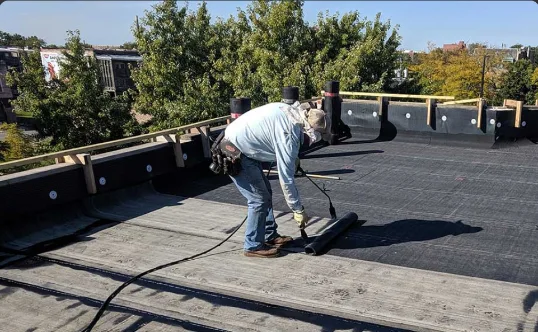
- Modified bitumen — asphalt-based rolls, torch-applied or self-adhered, often with a granule surface. Common on older Houston commercial roofs and residential flat sections. Seams and flashing details are the usual failure points.
- Built-up roofing (BUR) — layers of felt and hot asphalt, the old standard, sometimes finished with gravel. Heavy, durable, and hard to diagnose when it leaks because water travels between layers. Core sampling is often the only way to know what is wet underneath.
A good contractor identifies the system before quoting anything. If someone offers to repair your flat roof without knowing which membrane it is, that is a reason to get a second opinion. GAF’s commercial roofing systems page describes the main flat-roof systems, including TPO, PVC and coatings.
How a Flat Roof Leak Is Actually Found
On a flat commercial roof, the stain inside is rarely below the failure. Water enters at one point, runs across the deck or along a joist, and drops through wherever it finds a gap — often the length of a suite away from where it came in. Above a suspended ceiling it can travel further still, and the ceiling tile that finally gives way tells you almost nothing about where to look.
So a proper flat-roof diagnosis does not start with a patch. It starts with finding the water:
- Visual inspection — seams, penetrations, flashings, drains and rooftop equipment, walked in full. Seam probes find where a weld has released rather than patching what is visible.
- Thermal imaging — an infrared scan shows where insulation under the membrane is wet, because wet insulation holds heat differently from dry. The scan maps how much of the roof is saturated and where.
- Moisture meter — confirms that what the scan found is actually water, not a shadow or a temperature quirk.
- Core sample — a small cut through the membrane shows what the layers are doing where nothing else can reach: which layers are wet, whether the deck is sound, and how deep the damage goes.
That diagnosis decides the repair. If the saturation is localised, it is a repair. If it is widespread, the answer is different — see the next section. A contractor who patches the first wet spot they see, without scanning, is guessing.
Repair vs Recoat vs Replace
Not every flat-roof problem needs a new roof, and not every flat roof can be saved by a patch. The honest decision follows the diagnosis:
- Repair — when the damage is localised: a puncture, a failed seam, a flashing joint, a blocked drain, a small area of saturated insulation. The failed section is cut out, the deck is checked, a patch matched to the existing membrane is welded or adhered in, and the seams are sealed. Most flat-roof calls end here.
- Recoat (restoration coating) — when the membrane is worn across a wide area but the deck underneath is dry and sound. A silicone or acrylic coating — including reflective cool-roof coatings — is applied over the whole roof, sealing seams and small cracks and typically adding 10–15 years of life. It is usually the better economics when the wear is widespread and the deck is dry. Our roof coatings page covers this in detail.
- Replace — when the deck is saturated across a large area, the membrane has failed in multiple places, or the roof has been patched so many times that the patches are the roof. Replacement means stripping back to the deck, fixing the deck and drainage, and installing a new system. A full replacement also needs the local paperwork — City of Houston re-roof permits and Harris County building code apply, with TDI windstorm compliance where it applies — and your contractor handles the permit as part of the job.
- Re-slope with tapered insulation — when ponding is the problem and the deck has settled. Tapered insulation is laid under a new membrane (or under a coating system) to rebuild the slope toward the drains without rebuilding the structure. It is the standard fix for a flat roof that ponds because the deck has sagged.
The wrong choice costs real money in both directions: replacing a roof that needed a patch, or patching a roof that needed replacing and paying for the same leak three times. A written inspection report with the scan results is what lets you tell which one you are looking at. Larger flat-roof work in Houston, such as a full replacement or re-sloping, may need a City of Houston permit — check the City of Houston permits page before work starts.
Why a Repair Made in the Rain Fails
If water is coming in right now, the first job is to stop it — tarp it, stabilise it, protect what is underneath. But a permanent flat-roof repair cannot be made on a wet membrane. Sealant does not bond to a wet surface, and a patch welded or glued onto a wet membrane fails within months.
On an occupied building the order is: stop the water and protect the interior first, then do the permanent repair when the roof is dry. If someone offers to permanently fix a flat-roof leak in the middle of a rainstorm, ask what happens when the patch lets go. Our emergency roof repair page covers what to do while you wait.
What Flat Roof Repair Costs
There is no single price for flat roof repair, because the cost follows the system, the size of the failed area, and whether the deck underneath is wet. What we can give you is the honest frame: every figure below is a published US national range from HomeGuide and Angi — not Houston prices and not RoofDetect Pro’s prices. Your contractor’s written estimate is the only price that matters for your roof.
- Minor repairs (a puncture, a short failed seam, a flashing joint): national range $150–$1,000.
- Moderate repairs (a larger membrane section, a drain rebuild, a parapet flashing run): national range $1,000–$3,000.
- Major work (widespread membrane failure, a saturated deck section, a full recoat or partial replacement): national range $3,000–$6,000+, and a full flat-roof replacement on a commercial building runs well beyond that, priced by the square foot and the system chosen.
What moves a job up the scale: saturated insulation that has to come out, a deck that needs repair, access problems (a roof three storeys up with no lift access), and the system itself — a built-up roof with water between layers costs more to diagnose and fix than a single-ply membrane with one bad seam. Get the inspection and the written estimate first; a price given over the phone, without anyone seeing the roof, is not a price.
Maintenance That Prevents Leaks
Flat roofs need more maintenance than pitched roofs, because they have no gravity helping them. The schedule that works in Houston:
- Inspect twice a year — in March and November — and after every heavy rain. March catches winter damage before storm season; November catches storm-season damage before winter. After a big storm, check the drains first.
- Clear the drains and scuppers. Leaves, silt and debris are the most common cause of ponding, and the cheapest problem to prevent.
- Walk the seams and flashings. Look for lifted edges, open seams, cracked sealant at parapets and curbs, and any new rooftop penetration (a new vent, a new unit) that was cut in without proper flashing.
- Limit foot traffic. Every footstep is a puncture risk. If people have to walk the roof, walkway pads on the traffic paths are cheap insurance.
- Keep a record. Photos and a short note after each inspection — what was checked, what was found — are the record that supports a manufacturer coverage question, an insurance claim, or a sale later.
A flat roof that is inspected twice a year and kept clear of debris lasts years longer than one that is only looked at when it leaks. The inspection is free — call (831) 623-8078 and ask for a flat roof inspection.
When a Flat Roof Leak Is an Emergency
Most flat-roof leaks are repairs, not emergencies. It is an emergency when water is actively coming into an occupied space, when a ceiling is sagging or bulging, when a large section of membrane has lifted or torn off in wind, or when the leak is over electrical equipment. In those cases, see our emergency roof repair page — stop the water first, then repair the roof. If the damage came from a storm — wind-lifted membrane, hail, or a fallen tree — see our storm damage roof repair page for the claim steps that follow.
The 48-hour rule is the test Houston flat-roof owners use
If water is still standing on a flat roof 48 hours after the rain stopped, it is a defect, not a puddle — and commercial roofing guides list it as a high-urgency sign. The usual causes are a blocked drain or scupper, a settled low spot, or too few drains for the size of the roof.
A tube of caulk is not a flat-roof repair
In a public Houston review, a homeowner describes a flat-roof leak “repaired” with caulking alone — and leaking from the same spot on the first major rain. A flat-roof fix has to name the failure it addresses: an open seam, failed flashing, a blocked drain or a punctured membrane.
Flat Roof Repair in Houston, TX — FAQs
How do I know if my flat roof needs repair or replacement?
The scan decides it. Localised saturation is a repair. Widespread wear with a dry deck is usually better economics as a restoration coating. A saturated deck across a large area, or a membrane that has failed in many places, is a replacement. Get a thermal scan and a written report before deciding — a guess costs more than the inspection.
How long should water stand on a flat roof after rain?
No more than 48 hours. Water still standing 48 hours after the rain stopped is a defect — it adds weight, degrades the membrane, and can void manufacturer coverage. The cause is usually a blocked drain, a settled deck, or equipment installed without regard for drainage.
Can a flat roof leak be fixed in the rain?
Temporarily, yes — tarp it and stabilise it. Permanently, no. Sealant and patches do not bond to a wet membrane, and a repair made in the rain fails within months. The permanent repair happens when the roof is dry.
What is the best flat roofing material for Houston?
There is no single best — it depends on the building. TPO is the most common on Houston commercial roofs because it is white, reflective and cost-effective. PVC fits restaurants and buildings with grease exhaust. EPDM and modified bitumen are common on older roofs. The right choice follows the building’s use, the budget, and what is already up there.
How much does flat roof repair cost in Houston?
It depends on the system and the size of the failed area. As a frame, published US national ranges (HomeGuide, Angi — not our prices) run $150–$1,000 for minor repairs, $1,000–$3,000 for moderate repairs, and $3,000–$6,000+ for major work. Your contractor’s written estimate is the only price that applies to your roof. These are US national ranges, not Houston prices — for flat roof repair Houston TX, your contractor’s written estimate is the only price that matters.
Why does the leak inside never line up with the damage on the roof?
Because water travels. It enters at one point, runs across the deck or along a joist, and drops through wherever it finds a gap — often far from where it came in. That is why a proper diagnosis uses a thermal scan and a moisture meter instead of patching above the stain.
What causes flat roof seams to fail?
Heat cycling, age, UV exposure, and movement in the deck. Seams open slowly — a weld releases a little at a time — so a seam can look fine from above and leak badly below. Seam probes during an inspection find the release before it becomes a leak.
Can you coat a flat roof instead of replacing it?
Yes, when the deck underneath is dry and sound and the wear is widespread. A silicone or acrylic coating seals the whole surface and adds years of life. When the deck is saturated, coating over it traps the water — replacement is the honest answer.
How often should a flat roof be inspected in Houston?
Twice a year — March and November — and after every heavy rain or storm. Flat roofs have no gravity helping them, so small problems become big ones faster than on a pitched roof. Regular checks are the cheapest part of flat roof repair Houston TX — they catch ponding and seam problems before they become leaks.
Do you repair flat roofs on homes as well as commercial buildings?
Yes. Residential flat sections — additions, garages, porches — are repaired the same way as commercial flat roofs: identify the system, find the water with a scan, and fix the failure point. Call (831) 623-8078 and tell us what kind of building it is. Flat roof repair Houston TX covers residential flat sections and commercial roofs alike.