
Storm Damage Roof Repair in Houston, TX
A storm just came through Houston and your roof took the hit — missing shingles, a leak, dents you can see from the ground, or damage you cannot see at all. What you do in the next 24 hours decides how well the repair goes, and how well the insurance claim goes. This guide explains how storm damage roof repair Houston TX works, from the first 24 hours to the finished repair.
By RoofDetect Pro — Last updated: November 17, 2026
RoofDetect Pro connects you with independent roofing contractors in Houston, TX for storm damage roof repair: hail damage, wind-lifted and torn shingles, hurricane damage, fallen trees and debris, emergency tarping, and the insurance claim that usually follows. Tell us what’s wrong and we match you with a local contractor who documents the damage properly, makes the roof watertight, then repairs it. Every storm damage roof repair Houston TX job starts with documenting the damage before any repair begins.
Call (831) 623-8078 — free roof inspection, no obligation.
Availability varies by ZIP code, time and service — call (831) 623-8078 to confirm. Weekend and holiday availability is not guaranteed everywhere.
This page covers the Houston storms that damage roofs, what hail and wind damage really look like, what to do in the first 24 hours, the insurance claim step by step, ACV vs RCV, your deductible, the Texas one-year filing deadline, TWIA and the windstorm certificate, what insurance does not cover, and what to do when a claim comes back too low.
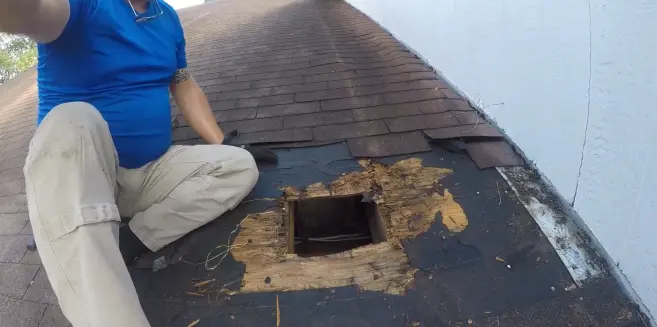
Houston Storm History That Matters
Houston does not get one kind of storm. It gets all of them, and each one damages roofs differently:
- Hurricane Harvey, August 2017 — the flood benchmark. Harvey’s lesson for roof claims is still the most important one in this city: wind damage and flood damage are different coverages, and thousands of Houston owners found out too late that they had one and not the other. See Flood vs Wind below.
- Hurricane Beryl, July 2024 — the most recent hurricane to hit the Houston metro directly, with widespread wind damage, torn shingles, fallen trees and power outages across Harris County and the suburbs.
- The May 2024 derecho — a straight-line wind event with gusts near 100 mph that tore through downtown Houston and the inner loop, lifting roofs, stripping shingles and throwing debris. A derecho does in minutes what a hurricane does in hours.
- Spring hail on the I-10 corridor — Houston’s hail season runs through spring and early summer, and the hail cells that track along the I-10 corridor are the ones that damage roofs most often. Harris County records more hail events per year than most counties in Texas.
- Hurricane season, June through November — the long season. Hail is concentrated in spring and early summer; hurricane wind loads run June through November; and Houston’s flat topography lets squall lines travel long distances without breaking up.
A roof that survived Beryl can still be damaged by the next spring hail cell. In Houston, storm damage is not a one-time event — it is the climate. That is why storm damage roof repair Houston TX starts with a full inspection, not with a patch.
Hail Damage — What It Really Looks Like
Hail damage is the most misunderstood kind of roof damage, because the worst of it is invisible from the ground.
- Granule loss — hail knocks the protective granules off asphalt shingles. A shingle that has lost its granules looks dull or bruised, and without granules the asphalt mat is exposed to UV and fails years early. Even marble-size hail can strip granules.
- Bruised and fractured mat — a hailstone hits hard enough to bruise or crack the shingle mat underneath the granules. From the ground the shingle can look fine. Pressed gently, a bruised shingle feels soft or spongy where the mat has broken. This is functional damage, not cosmetic — the shingle no longer protects the roof.
- Soft-metal dents — gutters, downspouts, vents, flashing and HVAC fins dent easily, and those dents are often the clearest evidence of hail size and direction. An adjuster reads soft metal first, because it does not lie.
- Cracked and broken shingles and tile — larger hail cracks shingles outright and breaks tile. Tile that looks intact can be cracked underneath.
- The 1-inch rule — hail above 1 inch in diameter (quarter-size, the National Weather Service severe-hail threshold) typically meets the threshold for functional damage on standard 3-tab and architectural shingles. Smaller hail can still cause granule loss, but 1 inch is the line most carriers recognise.
- Hyperlocal hail — Houston hail is hyperlocal. A cell that tagged Meyerland can skip Bellaire entirely. Two houses on the same street can have completely different damage. That is why a claim needs storm data for your exact address, not for the city — see the claim section below.
If your neighbours are getting new roofs after a storm and yours “looks fine” from the driveway, get an inspection anyway. Hail damage hides, and the one-year filing clock is already running.
Wind Damage — What You Can’t See From the Ground
Wind does not simply push on a roof. It creates negative pressure — suction — on the leeward surfaces that peels roofing materials off the deck, and it acts on the underside of overhangs to lift shingles even when the wind is not blowing directly onto the roof.
- Lifted and creased tabs — the most common wind damage. A shingle lifts, creases at the bend, and settles back down looking almost normal. The crease breaks the seal strip, and the next rain gets under it. Standard three-tab shingles begin to lift at 50–60 mph — and a severe thunderstorm warning starts at 58 mph.
- Broken seals you can’t see — the adhesive seal between shingle courses fails in wind and never re-seals properly. From the ground the roof looks intact; on the roof, whole courses lift by hand.
- Torn and missing shingles — the visible damage. A slope stripped by wind leaves underlayment and decking exposed to the next rain, and that is an emergency, not a repair to schedule next month.
- Deck uplift and structural damage — in the worst winds, the deck itself lifts or the structure racks. Hidden structural racking is one of the things storm claims most often miss.
- Ratings matter — standard three-tab shingles are typically rated only to 60–70 mph. When storm winds exceed the rated resistance of the roof system installed on your home, damage is expected, and it is typically covered. That comparison — wind speed at your property against the rating of your roof — is part of a properly documented claim.
- The 25% rule and how a roof is fastened — if wind damage affects more than 25% of a continuous roof plane, local building codes may require replacing the entire slope rather than patching it. A properly built Houston roof uses high-wind rated shingles with hand-sealed tabs and 6-nail fastening patterns rated for 130–150 mph wind uplift. And a creased shingle cannot be glued back to strength — once wind uplift fractures the fiberglass mat, the shingle must be replaced.
- Flat and low-slope roofs take wind damage differently — membrane lift, torn seams and ponding after the storm, rather than lifted shingles. See our flat roof repair page for how that damage is found and fixed.
Wind damage and hail damage often arrive together, and they are documented differently. A good inspection records both, in the language an adjuster is trained to accept: measured granule loss, fractured mat, compromised seal strips — not “looks bad”.
What to Do in the First 24 Hours
The first day after a storm decides the claim. Do these in order:
- Make sure everyone is safe. Downed power lines, a sagging ceiling, a tree through the roof — call emergency services first. Stay out of rooms with bulging ceilings.
- Take photos and video — before you clean anything up. Photograph the roof from the ground, the damage inside, the hailstones if any are still on the ground (put one next to a coin for scale), and anything the water has touched. Do not tidy up the damage before photographing it. These photos are the start of your insurance record.
- Tarp it if water is coming in — see our emergency roof repair page for how tarping works. A tarp stops the water today; the repair fixes the roof. This is also your duty under most policies — see Mitigation below.
- Do not throw anything away. Damaged shingles, ceiling pieces, dented vents — your insurer may want to see them. Bag them and keep them.
- Write down the date and time the damage happened, and the storm’s name if it had one. The one-year filing deadline runs from the date of damage.
- Call for an inspection before you call your carrier. A documented inspection — photos, measurements, a written report — is what turns “my roof is damaged” into a claim a carrier can work with. Call (831) 623-8078 for a free storm inspection.
- Do not start permanent repairs yet. Temporary protection, yes. Permanent repair, no — not until the damage has been documented and the claim is underway. Starting permanent work before the adjuster sees the damage can cost you the claim.
What not to do: do not climb onto a wet, storm-damaged roof; do not sign anything with a contractor who knocks on your door the morning after a storm before you have read it; and do not let anyone on your roof with a hammer — real storm damage is found with chalk and a camera, not created with a hammer.
The Insurance Claim, Step by Step
A storm claim is a process, not a phone call. Here is how it works in Houston: The Texas Department of Insurance’s guide to insurance and your roof explains what to know when buying a policy or filing a claim.
- Document — the inspection photographs and measures everything: hail hits, lifted tabs, broken seals, soft-metal dents, interior water — drone and thermal imaging where they help, with dated, geotagged photos and attic moisture readings. The report is written in the language adjusters use. Storm data for your ZIP code is pulled — NOAA storm reports that confirm hail or wind activity hit your address, because hyperlocal hail means the carrier will ask for proof your street was in the damage zone.
- File — you call your carrier and open the claim, giving the date of damage and the inspection findings. Keep the claim number and the name of everyone you speak to.
- Adjuster visit — the carrier sends an adjuster to inspect the roof. A roofing contractor can meet the adjuster on site to make sure all storm-related damage is identified — this walkthrough matters, because what the adjuster does not see does not get into the scope.
- Scope and estimate — the adjuster writes a scope of the covered damage and a price for it, usually in Xactimate, the estimating software carriers use. The scope is the document that decides what gets paid for.
- Repair — once the scope is agreed, the contractor repairs or replaces the roof to the scope. If the scope is short — and scopes often are — see When the Claim Comes Back Too Low below.
- Final payment — the recoverable depreciation is released after the work is done and documented, if your policy is replacement-cost. Keep every receipt and photograph the finished work.
One rule runs through all of it: roofer first, carrier second. Get the damage documented by someone who knows roofs before the carrier’s adjuster writes the only record that counts. And remember your duty to mitigate — tarp and dry the property before the adjuster arrives. Most standard policies obligate you to take reasonable steps to prevent further damage, and failing to do so can give the carrier grounds to reduce or deny the claim. The Insurance Information Institute’s guide to filing a homeowners claim walks through the same steps — document the damage, file the claim, and work with the adjuster.
ACV vs RCV in Plain English
Two terms decide how much money a claim pays. They are on every Texas homeowner policy, and most owners only learn them after a storm:
- ACV — Actual Cash Value. What your roof is worth today, after depreciation. A 15-year-old shingle roof is worth much less than a new one, and an ACV settlement pays that depreciated value. ACV is what you get first, and on an ACV-only policy it is what you get, full stop.
- RCV — Replacement Cost Value. What it costs to replace the roof with new materials today, with no deduction for age. An RCV policy pays the ACV amount first, then releases the rest — the recoverable depreciation — after the work is done and documented.
The difference between the two on a Houston roof can be thousands of dollars. Check which one your policy is before you file, not after the first cheque arrives.
Your Deductible Is Probably a Percentage
Most Houston-area policies do not have a flat-dollar deductible for wind and hail. They have a percentage deductible — often 1% to 5% of your coverage amount. On a home insured for $300,000, a 2% wind/hail deductible is $6,000 out of your pocket before the carrier pays anything.
That number surprises almost everyone, and it changes the maths of a claim: a repair that costs less than your deductible is not worth filing, because the claim still goes on your history. Texas law also matters here — your deductible is yours to pay, and no contractor can legally “waive” or “absorb” it for you. Anyone who offers to do that is offering to commit insurance fraud with your policy.
Know your deductible before you file. It is on your policy declarations page.
The Texas One-Year Filing Deadline
Texas gives you one year from the date of damage to report a wind or hail claim. That sounds generous until you realise how quietly hail damage hides and how fast a year passes. Beryl damage, for example, is covered under standard wind/hail provisions only if you filed before your policy’s storm reporting deadline — typically one year from the event date in Texas.
TWIA — the Texas Windstorm Insurance Association, which covers wind and hail near the coast — also gives you one year from the date of damage to report, and then has 60 days to decide on the claim and 10 days to pay after accepting it. For who TWIA covers and how to report a claim, see the Texas Windstorm Insurance Association website.
The practical rule: if a storm hit your area, get the inspection within weeks, not months. The deadline runs from the storm, not from when you noticed the stain.
TWIA / WPI-8 Windstorm Certificate
Near the coast, a regular homeowner policy may not cover wind and hail at all. In those areas — including parts of Harris County close to Galveston Bay — owners often buy a separate windstorm policy through the Texas Windstorm Insurance Association (TWIA). Your claim then goes to TWIA for the wind portion and to your regular carrier for everything else.
Two things to know about TWIA:
- It requires proof that your building was built or repaired to windstorm code. After repairs, a certified inspector issues a certificate, often called a WPI-8. Without it, you can lose eligibility for future coverage. If your roof is replaced under a TWIA claim, the WPI-8 inspection is part of the job — ask your contractor about it before the work starts.
- Do not start permanent repairs or throw away damaged materials before talking with a TWIA claims examiner. TWIA asks owners not to, and doing so can damage the claim.
If you are not sure whether your wind coverage is TWIA or a standard policy, check the declarations page — it will say. If you are rebuilding to a stronger standard, the IBHS FORTIFIED Roof program sets out storm-proofing requirements above the code minimum.
Flood vs Wind — The Harvey Gap
Hurricane Harvey in 2017 proved how costly one gap can be across Harris County: thousands of owners had wind coverage but no flood policy at all.
The rule is simple and brutal: water that comes through a damaged roof is usually covered. Water that rises from the ground is flood, and standard policies exclude it. Harvey’s water rose from the ground. Roofs that were wind-damaged in the same storm were covered for the wind; the floodwater in the living room was not, unless the owner had a separate flood policy.
Check both policies before you file a storm damage claim after a hurricane — wind and flood are different claims, to different carriers, with different deadlines.
What Insurance Does NOT Cover
A standard Texas homeowner policy covers sudden, accidental damage from wind and hail. It does not cover:
- Age and wear. A 25-year-old roof that is simply worn out is not a storm claim. Insurers pay for damage the storm caused, not for wear that was already there — and they will say so when the roof is old and the damage is thin.
- Damage you already knew about and ignored. A leak you watched for two years before the storm is not the storm’s fault.
- Maintenance failures. Clogged gutters, rotten decking from years of small leaks, flashing that was never sealed — those are maintenance, not storm damage.
- Flood. See above — rising water needs a separate flood policy.
- The cosmetic-damage trap. Some policies carry a cosmetic damage exclusion, and carriers sometimes apply it to functional hail damage — a bruised mat that no longer protects the roof, labelled “cosmetic” because the shingle still looks whole from the ground. Functional damage is not cosmetic, and a documented inspection is how you prove the difference.
If your roof is old, be honest with yourself before filing: a claim on a worn roof is the one most likely to be denied, and a denied claim still sits on your record.
When the Claim Comes Back Too Low
Storm claims are commonly underpaid. The usual reasons: the damaged roofing is said to be already deteriorated, the scope is limited to the visibly damaged slope, a cosmetic damage exclusion is applied to functional hail damage, the wind speeds at the property are disputed, or interior water is denied as a separate issue. Hidden damage — structural racking, wind-driven rain infiltration — is missed most often of all.
If the scope comes back short, you have options:
- Ask for a re-inspection with your contractor present. A second look with the adjuster on the roof, pointing at the measured damage, changes scopes more often than a phone argument does.
- Get a second opinion from another roofing contractor, with its own written report. Two documented inspections carry more weight than one.
- Consider a licensed public adjuster. A public adjuster works for you, not the carrier — they document the full scope of exterior and interior damage and present it under the policy, from roof replacement to interior water mitigation. They are paid from the settlement, so understand their fee before hiring one. They are the right call when the gap between the scope and the real damage is large, not for a small shortfall.
Do not accept a scope you know is wrong just to get the job moving. A roof repaired to a short scope is a roof that leaks again — and the second claim is harder than the first.
What Storm Damage Roof Repair Houston TX Costs
Storm repair has two prices: what the work costs, and what your deductible is. The work itself is priced in the claim scope, not from a menu — but the frame below is the honest starting point. Every figure is a published US national range from HomeGuide and Angi — not Houston prices and not RoofDetect Pro’s prices.
- Minor storm repairs (a few lifted shingles re-sealed, a small flashing fix, a tarp and a patch): national range $150–$1,000.
- Moderate storm repairs (a slope re-shingled, a flashing system rebuilt, a valley replaced): national range $1,000–$3,000.
- Major storm work (a full slope or full roof replacement after hail or wind): national range $3,000–$6,000+, and a full replacement runs well beyond that depending on the material and the size of the roof.
On top of that sits your deductible — usually 1% to 5% of your coverage for wind and hail in Houston. The carrier pays the scope minus the deductible; you pay the deductible. If the repair costs less than your deductible, filing is usually not worth it. Your contractor’s written estimate and the adjuster’s scope are the only numbers that apply to your roof.
Before you file, do the deductible maths
Many Texas policies carry a wind and hail deductible of 1–2% of the home’s dwelling coverage, and many require hail damage to be reported within one year of the storm. If the repair costs about the same as the deductible, the claim may pay nothing — so get an inspection and a written scope first, then decide with the numbers in front of you.
The adjuster only sees what is shown
Texas Department of Insurance tells homeowners to photograph and video the damage, list it inside and out, and be present for the adjuster visit so nothing is missed. Dented gutters, torn window screens and a dinged AC unit are easy to overlook — and they are often what dates and confirms the storm.
If a roofer offers to waive your deductible, walk away
Texas Department of Insurance states plainly that waiving a homeowner’s deductible is illegal under state law, and Texas law requires contracts of $1,000 or more involving an insurance settlement to state that the policyholder must pay the deductible. Any contractor making that offer is asking you to take part in the offence.
Beryl was “only” a Category 1 — and it still lifted shingles across Houston
The National Weather Service recorded gusts of 83–84 mph at Houston’s airports on 8 July 2024, and the May 2024 derecho may have topped 100 mph in places. After a storm like that, the roof needs a full check, not a glance from the driveway: lifted shingles, broken seal strips and flashing that moved are the damage that leaks weeks later.
Storm Damage Roof Repair in Houston, TX — FAQs
Should I call a roofer or my insurance company first after a storm?
A roofer first. Get the damage documented — photos, measurements, a written report — before the carrier’s adjuster writes the only record that counts. Then file the claim with the documentation in hand. For storm damage roof repair Houston TX, the order is always the same: roofer first, carrier second.
How long do I have to file a storm damage claim in Texas?
One year from the date of damage for wind and hail, on most standard policies and on TWIA. The clock runs from the storm, not from when you noticed the damage — so get the inspection within weeks, not months.
Will my insurance cover hail damage to my roof?
If the hail caused functional damage — granule loss, a bruised or fractured mat, broken seals — yes, under standard wind/hail provisions. Cosmetic-only damage may be excluded if your policy has a cosmetic damage exclusion, which is why the damage has to be documented as functional, not just photographed. If the damage is functional, storm damage roof repair Houston TX is usually covered — check your policy for a cosmetic-damage exclusion.
What does hail damage look like on a roof?
Granule loss, soft or spongy spots where the mat is bruised, dents in gutters and vents, and cracked shingles or tile. From the ground, a hail-damaged roof often looks fine — which is why an inspection on the roof matters.
How much is my wind/hail deductible?
Most Houston-area policies use a percentage deductible for wind and hail — often 1% to 5% of your coverage amount. On a $300,000 home, 2% is $6,000. Check your policy declarations page; it is not a flat dollar amount.
What is the difference between ACV and RCV?
ACV (Actual Cash Value) is what your roof is worth today after depreciation. RCV (Replacement Cost Value) is what a new roof costs today. An RCV policy pays the ACV amount first, then releases the rest after the work is done and documented.
What is TWIA and do I need it?
TWIA is the Texas Windstorm Insurance Association — the windstorm insurer for coastal areas where regular policies exclude wind and hail, including parts of Harris County near Galveston Bay. If your wind coverage is TWIA, your wind claim goes to TWIA and the rest to your regular carrier. TWIA is the windstorm insurer behind many storm damage roof repair Houston TX claims near the coast.
What is a WPI-8 certificate?
A certificate issued by a certified inspector after windstorm repairs, proving the work was built to windstorm code. Without it, you can lose eligibility for future TWIA coverage. Ask your contractor about the WPI-8 inspection before a TWIA-funded replacement starts.
Does insurance cover flood damage to my roof?
Water that comes through a damaged roof is usually covered. Water that rises from the ground is flood, and standard policies exclude it — that needs a separate flood policy. Harvey proved how expensive that gap is.
What should I do before the adjuster arrives?
Photograph everything before cleaning up, tarp the roof if water is coming in, keep damaged materials, and write down the date and time of the storm. Your policy also requires you to mitigate further damage — failing to tarp and dry the property can reduce or deny the claim.
What if my claim is denied or the scope is too low?
Ask for a re-inspection with your contractor present, get a second opinion with its own written report, or consider a licensed public adjuster — they work for you, not the carrier, and document the full scope. Do not accept a short scope just to get moving.
Can I stay in my home during storm damage repairs?
Usually yes for repairs. For a full replacement, most homeowners stay — it is loud for a day or two, and the crew will tell you which rooms to keep clear. If the roof is structurally unsafe or the ceiling is sagging, stay out until a contractor says it is safe.