
Emergency Roof Repair in Houston, TX
Water is coming in, shingles are missing, or a tree hit your roof. You need help now — and you need the damage stopped before it gets worse. That is what emergency roof repair Houston is for: stop the water first, then repair the damage at its source.
By RoofDetect Pro — Last updated: November 20, 2026
RoofDetect Pro connects you with independent roofing contractors in Houston, TX for emergency roof repair: active leaks, storm and hail damage, missing and lifted shingles, fallen trees and branches, exposed decking, and sagging ceilings. Tell us what’s wrong and we match you with a local contractor who can make the roof watertight first, then repair it properly. Every emergency roof repair Houston job starts with making the roof watertight, then repairing it properly.
Call (831) 623-8078 — free roof inspection, no obligation.
Availability varies by ZIP code, time and service — call (831) 623-8078 to confirm. Weekend and holiday availability is not guaranteed everywhere.
This page covers what counts as a roofing emergency in Houston, what to do right now while you wait, how emergency tarping works, what happens when you call, what emergency repair costs, and how insurance fits in. Houston storms — Hurricane Beryl in July 2024, the May 2024 derecho, and the spring hail along the I-10 corridor — are why emergency repair is one of the most-needed roofing services in this city. For current Houston storm alerts, see the National Weather Service.
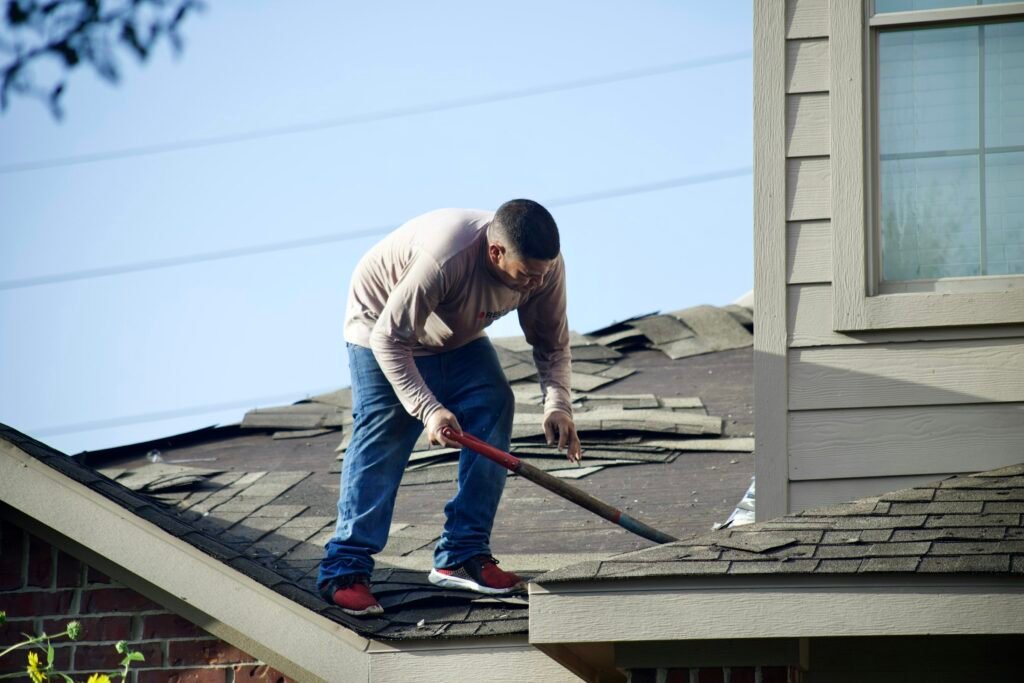
What Counts as a Roofing Emergency
Not every roof problem is an emergency. These are:
- An active leak — water dripping or running inside, a growing ceiling stain, or water pooling in the attic. Every hour it runs, the damage spreads to insulation, decking, drywall and wiring.
- Missing or lifted shingles over a wide area — one missing shingle is a repair; a whole slope stripped by wind leaves the underlayment and decking exposed to the next rain.
- A tree or large branch on the roof — weight and punctures, and the risk of more damage if it shifts. Do not try to move it yourself. A tree usually has to come off before a tarp can go on properly — the contractor will tell you whether tree removal is needed first and who handles it.
- Exposed decking or underlayment — the waterproof layers are gone and rain has a direct path in.
- A sagging ceiling or bulging drywall — water has pooled above it. It can come down without warning. Keep the room clear and do not stand under it.
- A visibly sagging roof section — decking or structure giving way after long-term water damage. Keep clear of the rooms below it and call now — this is structural, not cosmetic.
- A hole from hail or wind-blown debris — even a small hole lets in a surprising amount of water in a Houston downpour.
Not an emergency, but still worth a call soon: a small stain that appeared after rain and has since dried, a few granules in the gutter, one lifted shingle tab, or a slow drip you have caught in a bucket and that has stopped. Those are repairs — see the roof repair page — but do not leave them for months. Houston’s next storm is never far away.
If anyone is in danger — a sagging ceiling, sparking wires, a tree through the roof — call emergency services first, then call about the roof.
What to Do Right Now
While you wait for a contractor, these steps limit the damage. Do them in this order:
- Catch the water. Buckets, pots and towels under the drip. Move furniture, electronics, rugs and valuables out of the way. If a ceiling is bulging with water, put a bucket underneath and step back — do not poke it.
- Move valuables out of the attic if water is getting in there. Cardboard boxes soak through fast.
- Take photos and video — before you move anything you can. Photograph the leak inside, the damaged area outside (from the ground), and anything the water has touched. These photos are the start of your insurance record. Our guide to the signs you need roof repair after a Houston storm lists what to photograph first. Do not tidy up the damage before photographing it.
- Turn off power to the affected area if water is near lights, outlets or wiring. If you are unsure, leave it and call an electrician.
- Stay off the roof. A wet, damaged roof is slippery, and storm-damaged decking can give way underfoot. The contractor has the equipment for this. From the ground, note what you can see: missing shingles, a tree, a visible hole.
- Do not start the insurance claim yet — document first. Photograph everything, keep receipts for anything you buy (buckets, tarps), and write down the date and time the damage happened. The claim steps are covered below.
What not to do: do not nail a tarp down yourself in high wind, do not climb onto a wet roof, and do not throw away damaged shingles or ceiling pieces — your insurer may want to see them.
Emergency Tarping — What It Is and Why It Comes First
Emergency tarping is a heavy-duty waterproof tarp secured over the damaged area so rain cannot get in. It is a temporary fix, not a repair — it buys time until the roof can be fixed properly. Tarping is often the first step of emergency roof repair Houston work after a storm, because it stops further water damage while the full repair is planned.
Tarping usually comes first because a proper repair needs dry conditions and daylight, and because the next Houston storm may arrive before a repair crew can do the full job. A tarp stops the water today; the repair fixes the roof.
What a contractor does: measures the damaged area, lays the tarp so water runs off it (not under it), and secures it to solid structure — not to damaged shingles that will tear away. A tarp is typically left in place for days to a few weeks while the repair is scheduled and, where relevant, the insurance claim is assessed. It is not a roof, and it is not meant to stay up for months.
If the damage is small and the weather is dry, the contractor may go straight to repair and skip the tarp. If rain is forecast or the hole is large, tarping is the right first step. While rain is still falling, the contractor may also use a temporary wet-surface patch or an attic catchment to hold the water until the tarp goes on. Most standard homeowners policies cover emergency tarping as part of a storm claim — keep the receipt.
How a Tarp Is Secured — and What Can Go Wrong
A tarp only works if it stays put and sheds water. Done properly, it is measured to cover the damaged area with plenty of overlap, laid so water runs off it and not under it, wrapped over the ridge or the high edge of the damage, and secured with battens or furring strips screwed into solid decking — not nailed through shingles, which would punch new holes in the roof and create new leak points. The edges are anchored to structure that is sound, never to damaged shingles that will tear away in the next gust. Done badly, a tarp is worse than no tarp: one nailed through the shingles, or one that pools water instead of shedding it, adds damage while it looks like protection. That is why the securing method matters more than the tarp itself — and why it is worth asking the contractor how the tarp will be fixed down before they climb up.

What Happens When You Call
RoofDetect Pro is a referral service. Work is done by independent Houston roofing contractors — RoofDetect Pro does not have its own crew.
- You describe the damage — what’s leaking, what happened, when it started, and where you are in Houston. Photos help if you can send them.
- We match you with a local contractor who covers your ZIP code and the type of damage.
- The contractor calls you back to confirm the details and arrange a visit. Availability varies by ZIP code, time and service — call (831) 623-8078 to confirm. Weekend and holiday availability is not guaranteed everywhere.
- The visit: stop the water, then assess. The contractor makes the roof watertight first — usually tarping — then inspects the damage, photographs it, and explains what the repair involves.
- You get a written description of the work before the repair starts, so you know what is being fixed and why.
There is no obligation: the free inspection is free, and you decide whether to go ahead with the repair.
Storm Emergencies vs Leak Emergencies
They feel the same inside the house — water coming in — but they are different jobs:
- Storm emergencies (wind, hail, fallen trees) usually damage a wide area: whole slopes of shingles, flashing torn off, punctures from debris. They often need tarping over a large area, and they usually involve an insurance claim. Houston’s storm history matters here: Hurricane Beryl in July 2024, the May 2024 derecho with winds around 100 mph, and regular spring hail, especially along the I-10 corridor. If your damage came from one of these events, say so when you call — it helps the contractor and your insurer.
- Leak emergencies (a pipe boot failed, flashing gave way, a valley clogged) are usually localised: one entry point, one wet area. They still need a fast response, because a small leak left running rots decking. The fix is at the entry point, not at the stain — water travels along rafters and decking, so the stain is rarely directly below the leak. See the roof leak repair page for how leaks are traced, and the roof leak detection page for the detection methods.
Both kinds get the same first response: stop the water, document the damage, then repair at the source. After the repair, the IBHS FORTIFIED Roof program sets out storm-proofing requirements above the code minimum for homeowners rebuilding after storm damage.
A Tree Fell on Your Roof — What Happens Next
A tree through the roof is the most frightening Houston emergency, and the order of events matters:
- Stay out of the rooms underneath it. The tree’s weight can shift, and the structure below it may already be weakened. If anyone is in danger — sparking wires, a tree through the roof — call emergency services first, then call about the roof.
- Photograph the damage from the ground before anything is moved — the tree, the hole, the water inside. These photos are the start of your insurance record. Do not tidy up before photographing.
- The tree comes off first. A tarp cannot go on properly with a tree in the way. The contractor will tell you whether tree removal is needed first and who handles it — some jobs need a tree service before the roofer can start.
- Then the tarp, then the repair. Once the tree is off, the roof is tarped to stop the water, the damage is documented, and the permanent repair is planned — decking first, then the roofing on top of it. Do not try to move the tree yourself, and do not climb onto a roof with a tree on it.
Emergency Roof Repair Houston Cost Guidance
RoofDetect Pro does not set prices — the contractor quotes the work after inspecting it. These are published US national ranges, not Houston prices and not RoofDetect Pro’s prices, given so you know roughly what to expect. Angi’s storm damage repair cost guide publishes the national ranges behind these figures.
- Minor emergency repair (a few missing shingles, a failed pipe boot, a small flashing fix): roughly $150–$1,000.
- Moderate emergency repair (a section of shingles, valley or flashing work, a small tarp plus repair): roughly $1,000–$3,000.
- Major emergency repair (large tarping, tree damage, decking replacement, a whole slope): roughly $3,000–$6,000 and up.
What moves the price: how much of the roof is damaged, whether decking has rotted, the roof type (shingle, tile, metal, flat), how steep and how high the roof is, and whether the repair has to happen in the rain. Tarping on its own is usually the smaller part of the bill — the repair is the bigger part.
Your contractor’s written description will say what is included. If an insurer is involved, the contractor’s photos and written scope are what the adjuster works from — which is why documentation matters.
Insurance: Document Before You File
Most storm damage in Houston goes through a homeowner’s insurance claim. The order matters: The Texas Department of Insurance’s guide to insurance and your roof explains what to know when buying a policy or filing a claim.
- Photograph everything first — inside and outside, before anything is moved or cleaned up.
- Stop further damage — tarp the roof. Insurers expect you to prevent the damage getting worse, and tarping is part of that.
- Call your insurer and file the claim. Tell them when the damage happened and what caused it (storm, hail, wind, fallen tree). Keep the claim number.
- The adjuster visits — usually within days. Be there if you can, and have the contractor’s photos and written scope ready. The adjuster works from a pricing system called Xactimate; your contractor’s scope is the counterweight to it. If the adjuster wants to walk the roof, ask the contractor whether they can be there for the visit.
- Understand the two values: Actual Cash Value (what the damaged roof is worth now, after depreciation) and Replacement Cost Value (what the repair costs new). Your policy decides which one you are paid, and when.
- Texas deadline: in Texas you generally have one year from the date of the damage to file a claim. Do not wait months — evidence fades, and later storms muddy which event caused what.
- Windstorm cover: if you are in a coastal windstorm area, your windstorm cover may be through TWIA (Texas Windstorm Insurance Association), and a WPI-8 windstorm certificate may be needed after the repair. Your insurer will tell you if this applies.
What insurance usually does not cover: wear and tear, age, and maintenance problems — a 25-year-old roof that finally leaks is not storm damage, however inconvenient. That is a repair-or-replacement decision, not a claim. Filing a claim for wear or age can still leave a claim on your record even if it is denied, which can affect your premium — that is why the inspection documents storm damage separately from wear. And one Texas rule to know: a roofing contractor may not waive or absorb your insurance deductible — anyone offering a ‘free roof’ by waiving it is breaking Texas law.
For the full claim walkthrough, see the storm damage page. The Insurance Information Institute’s guide to filing a homeowners claim walks through the same steps — document the damage, file the claim, and work with the adjuster.
Emergency Repair by Roof Type
- Asphalt shingle — the most common Houston roof. Wind lifts tabs and breaks seals; hail cracks shingles and knocks granules off. Emergency repair is usually re-securing or replacing the damaged shingles and re-sealing the surrounding ones.
- Metal — wind can lift panels and loosen fasteners; hail dents panels but rarely punctures them. Repair is re-fastening, re-sealing seams, or replacing a panel.
- Tile (clay or concrete) — tiles crack or slip in storms, and the underlayment beneath them is what actually keeps water out. A cracked tile is urgent because the underlayment is now exposed.
- Flat / low-slope (TPO, modified bitumen, built-up) — punctures from debris and seam failures are the emergency. Ponding water after a storm makes a small puncture worse fast. See the flat roof repair page.
Houston’s older homes were often built with different flashing and ventilation standards than new builds, and the contractor factors the roof’s age and construction into the assessment — the same damage can mean a different repair on a 40-year-old roof than on a new one.
Whatever the type, the first step is the same: make it watertight, then repair at the source. That first step is the same for every emergency roof repair Houston job, whatever the roof type.
After the Emergency Repair
Once the roof is watertight and repaired:
- Book a full inspection — a storm that caused one visible emergency often caused smaller damage elsewhere (lifted tabs, bruised shingles, loose flashing) that will leak in the next storm. See the roof inspection page.
- Keep the paperwork — the contractor’s photos, the written scope, the invoice, and the claim number. If the same roof leaks again, this record is what everyone works from.
- Check the attic in a week — look for damp insulation or new stains after the next rain. If anything is still wet, call back.
- Think about the next storm — if this is the second or third emergency on the same roof, it may be time for the repair-vs-replacement conversation. Our hurricane preparation guide covers the pre-season check in detail. See the roof repair page.
Beryl was “only” a Category 1 — and it still lifted shingles across Houston
The National Weather Service recorded gusts of 83–84 mph at Houston’s airports on 8 July 2024, and the May 2024 derecho may have topped 100 mph in places. After a storm like that, the roof needs a full check, not a glance from the driveway: lifted shingles, broken seal strips and flashing that moved are the damage that leaks weeks later.
First hours after a storm: stop the water, don’t start the repair
Texas Department of Insurance advises covering holes and broken windows, removing standing water, saving every receipt, and holding off permanent repairs until the adjuster has seen the damage. A tarp is a stopgap that keeps the next rain out of the house — the permanent fix waits until the damage is documented.
Frequently Asked Questions
Is a leaking roof an emergency?
If water is actively coming in, yes — every hour it runs, the damage spreads. A small stain that has dried and is not getting worse is urgent but not an emergency; book a repair soon, before the next rain. If water is coming in, emergency roof repair Houston help should start with tarping to stop the water, then a proper repair.
Can you repair a roof in the rain?
A full repair needs dry conditions. In rain, the contractor tarps the roof to stop the water and returns to repair it when it dries. Emergency tarping is designed for exactly this.
How fast can someone come out?
It depends on your ZIP code, the time, and how busy contractors are — especially after a big storm, when every roofer in Houston is booked. Call (831) 623-8078 to confirm. Availability varies by ZIP code, time and service. Weekend and holiday availability is not guaranteed everywhere. After a big storm, demand for emergency roof repair Houston is high, so call as soon as you can and have photos ready.
Do I need a tarp, or can you just fix it?
If the damage is small and the weather is dry, the contractor may repair it directly. If rain is coming or the damage is large, tarping first is the right call — it stops the water today while the repair is scheduled.
Will my insurance cover emergency roof repair?
Storm, hail, wind and fallen-tree damage are usually covered, minus your deductible. Wear, age and maintenance problems usually are not. Document the damage with photos before anything is moved, and file within the Texas one-year deadline.
Should I call a roofer first or my insurer first?
Document and tarp first, then call your insurer to file the claim. A contractor’s inspection and photos before the adjuster visits give the adjuster something concrete to work from.
What is the difference between Actual Cash Value and Replacement Cost Value?
Actual Cash Value is what the damaged roof is worth now, after depreciation. Replacement Cost Value is what the repair costs new. Your policy decides which you are paid — check it before the adjuster visits.
How long can a tarp stay on my roof?
Days to a few weeks is normal, while the repair is scheduled and the claim assessed. A tarp is a temporary fix, not a roof — it is not meant to stay up for months.
A tree fell on my roof — what do I do?
Do not try to move it yourself, and stay out of the rooms underneath it. Call emergency services if anyone is in danger, then call about the roof. Photograph the damage from the ground before anything is moved.
My ceiling is sagging — is it going to fall?
It can come down without warning. Keep the room clear, put a bucket underneath, and do not stand under it or poke it. Call now.
How much does emergency roof repair cost?
RoofDetect Pro does not set prices. Published US national ranges — not Houston prices and not RoofDetect Pro’s prices — are roughly $150–$1,000 for a minor repair, $1,000–$3,000 for a moderate one, and $3,000–$6,000+ for major work. Your contractor quotes after inspecting. The cost of emergency roof repair Houston work depends on how much of the roof is damaged and whether decking has rotted.
The leak stopped — do I still need a repair?
Yes. A leak that stopped only stopped because the rain stopped. The entry point is still open, and the next storm will find it again — with the decking a little more rotted in the meantime.
What if the damage happened months ago?
You can still call, and you can still file a claim — Texas generally allows one year from the date of damage. But the longer you wait, the harder it is to prove which storm caused it, so do not wait any longer.
Do you work on commercial roofs too?
Emergency repair here covers residential roofs. For commercial and flat roofs, see the flat roof repair page and the roofing services hub.
Which areas of Houston do you cover?
RoofDetect Pro connects homeowners across Houston, TX — including Katy, Cypress, Spring, The Woodlands, Sugar Land, Pearland, Tomball, Humble, League City, Missouri City, Pasadena, Jersey Village, Baytown and surrounding suburbs. For example, our Tomball roof repair page covers emergency work in Tomball’s hail country in detail. Availability varies by ZIP code, time and service — call (831) 623-8078 to confirm.
Can a tarp be installed at night or in the rain?
Tarping can happen in the rain — stopping water is its whole job — and crews do work after dark after a storm. A full repair is different: it needs dry conditions and daylight. If conditions are too dangerous to climb, the first step is interior containment — sheeting over furniture, buckets under the drip — and the tarp goes on as soon as it is safe.
Will the tarp damage my roof?
A properly secured tarp does not — it is fixed with battens or furring strips screwed into solid decking, and wrapped over the ridge so water sheds off. A tarp nailed through shingles would punch new holes, which is why the securing method matters. Ask the contractor how the tarp will be fixed down before they climb up.
What if my roof is too steep or too high for a tarp?
Steep, fragile or multi-story sections are the hardest to tarp safely, and the contractor will say so rather than guess. If a section cannot be reached safely, the first step is interior containment and documentation — sheeting, buckets, photos — and the repair is planned from the inspection of the accessible areas.
Do I need a permit for emergency roof repair?
Emergency tarping itself is a temporary measure and does not need a permit. A permanent repair or replacement usually needs a City of Houston roofing permit — Angi’s Houston figures put the average permit fee around $62. Your contractor handles the permit as part of the permanent repair.
My power is out — can the roof still be tarped?
Yes. Tarping needs no power. Inside, the same first steps work without it — buckets under the drip, sheeting over furniture, valuables moved out of the way. If water is near lights, sockets or wiring, switch off the affected circuit if you can do so safely, and call an electrician if you are unsure.
Call (831) 623-8078 — free roof inspection, no obligation.
RoofDetect Pro is a referral service. Work is done by independent Houston roofing contractors.
13909 Mandolin Dr, Houston, TX 77070 · info@roofrepairinstallation.com · https://roofrepairinstallation.com/